Sign In
By signing in or creating an account, you agree with Associated Broadcasting Company's Terms & Conditions and Privacy Policy.
By signing in or creating an account, you agree with Associated Broadcasting Company's Terms & Conditions and Privacy Policy.
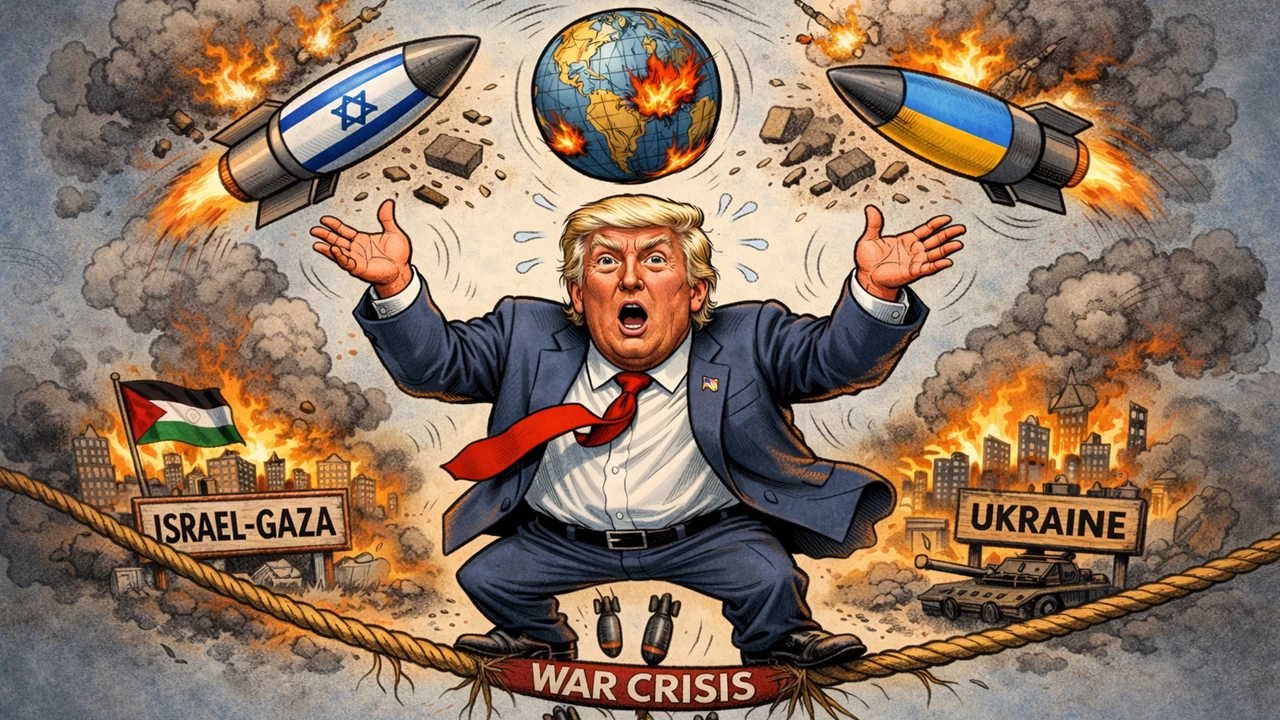


New Delhi: The Israel-Hamas war began on October 7, 2023. The one between Russia and Ukraine, in effect, started in 2014 with Russia's invasion of Crimea, but subsequent escalation into a full-fledged conflict started in 2022, making it the largest European conflict since World War II.
Both the conflicts are some of the biggest global conflicts currently underway, hugely impacting both global politics and economy. While many attempts have been made to bring about some semblance of peace in both the conflicts, they have so far not fared well. One thing common in the current endeavours at peace making is US President Donald Trump, and it will be interesting to see how his attempts fare in the coming year.
It is not that attempts have not been made to bring about peace in both the Israel-Hamas war and the one between Russia and Ukraine. Many international actors have sought interference, finally some progress has eventually been made in the case of Israel and Hamas, but not much in the case of Russia and Ukraine which still continues unabated.
In the Israel-Hamas conflict, multiple international initiatives have sought to halt violence and negotiate terms. In 2024–2025, the United Nations Security Council adopted resolutions urging ceasefires and hostage release agreements, including a three-phase plan endorsed by UNSC Resolution 2735. That and other such UN initiatives did not bring much sustained relief on ground as Gaza continued to be battered by military action.
Finally in October 2025, the US-led Gaza peace plan was announced alongside a multinational ceasefire and hostages exchange agreement. This came about after multiple attempts of diplomatic manoeuvres between the US, Egypt and Qatar. Finally, a US-backed peace plan has been enacted which is underway and its first phase is nearly completed. It can be seen as a massive success in a war which nearly a year ago looked unending.
In the Russia-Ukraine war, peace attempts have centered on diplomatic negotiations mediated by Western governments and international bodies. These included renewed calls for talks following the Minsk I and Minsk II agreements that came in 2014 to 2015 but ultimately stalled. More recently US-brokered proposals involving security guarantees and ceasefire frameworks have been optimistic. Despite intermittent talks and high-level diplomatic engagement, much has not been achievable on-ground in the case of the Russia-Ukraine war.
The current year has been a mixed bag for both the global conflicts. It started with military escalations continuing, and in the case of Russia-Ukraine they still continue.
What was common though was attempts at peace, minor ceasefires, sudden escalations, sanctions and the like. As the year ends, calls for optimism seem to be on the rise when it comes for the appearance of some peace on the horizon. Still a definitive statement cannot be made on the eventuality of both wars, there are still to look at.
In the Israel-Hamas context, the 2025 ceasefire and peace plan have significantly reduced active hostilities and a pathway for upcoming peace looks likely. The meeting between Donald Trump and Benjamin Netanyahu on December 29, 2025, could ensure continuation of the peace process. Trump is likely to have enforced his will on Netanyahu, pleading his case to have the peace process enter the second phase. Further support for peace from other parties in the Arab world could further accentuate this, and it looks, if not for long but at least for the start of the year 2026, hostilities between Israel and Hamas will only subside.
The case with the other global conflict, Russia and Ukraine though is completely different. Trump had a similar meeting with Ukraine’s Zelensky as well, but just after the meeting, accusations of escalations from both Kiev and Moscow showed that much is still wanting in terms of getting both parties to the table of peace.
A comprehensive end to the Russia-Ukraine war in 2026 thus looks improbable. Ongoing negotiations remain tentative as core disagreements over territorial integrity do not look to be resolved soon. Security guarantees for Ukraine and fulfilment of Russian objectives would both be difficult to reach. At best what can be expected is a ‘pause’ in hostilities as diplomatic efforts could be made to bring some compromises from both sides, rather than a full peace treaty, which currently seems a distant dream.