Sign In
By signing in or creating an account, you agree with Associated Broadcasting Company's Terms & Conditions and Privacy Policy.
By signing in or creating an account, you agree with Associated Broadcasting Company's Terms & Conditions and Privacy Policy.
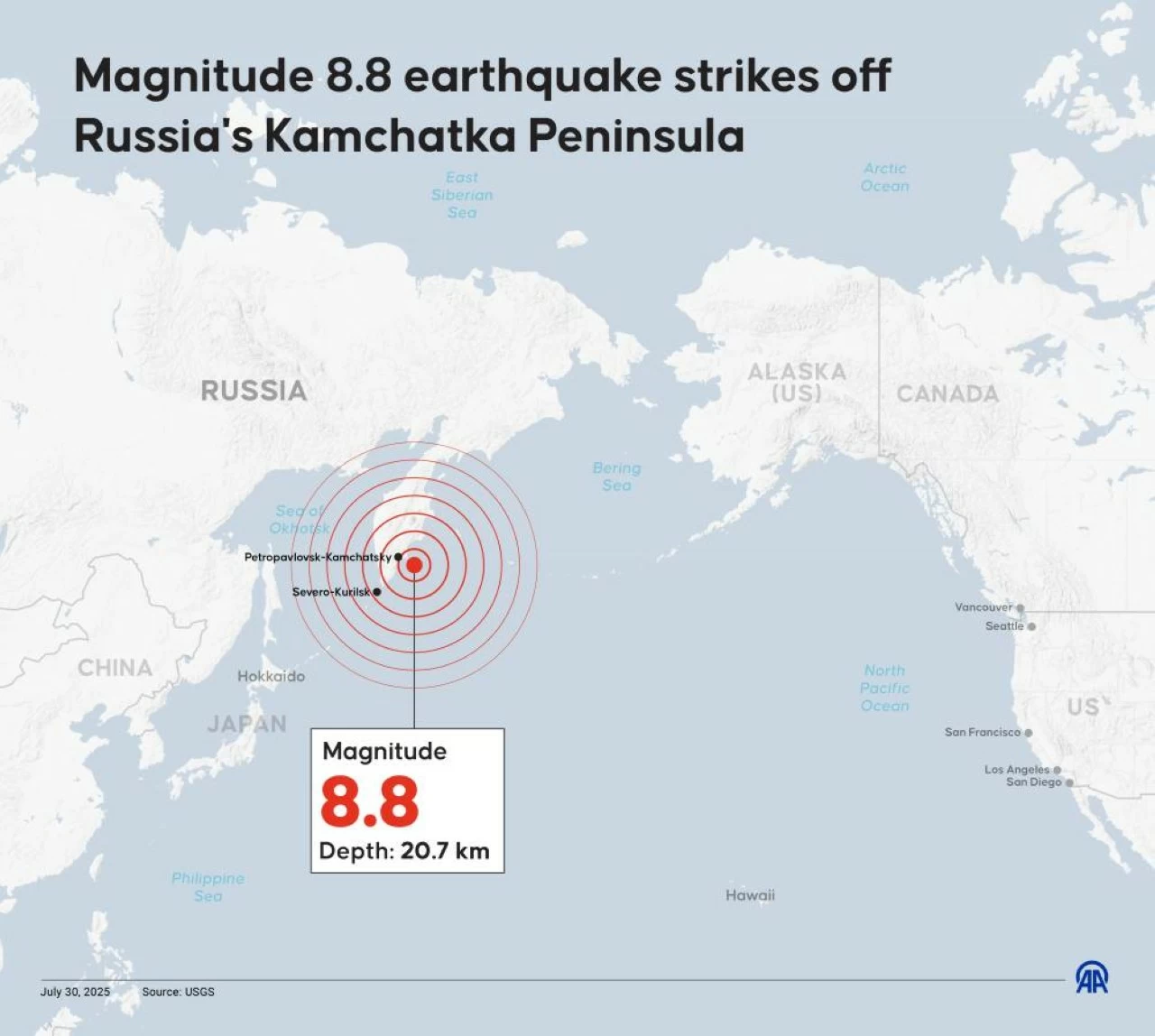

New Delhi: According to the US Geological Survey, an earthquake hit about 119 kilometers southeast of Petropavlovsk-Kamchatsky, Russia at a depth of 20.7 kilometers on Wednesday. It is the strongest quake on the planet since 2011 which hit northeast Japan triggering a massive tsunami. The disaster also ties in for the sixth-strongest quake ever recorded.
After the massive earthquake, tsunami warnings have been issued for multiple nations across the Pacific belt. As the earthquake waves take effect, many regions in Russia and Japan are seeing initial tsunami waves hit their shores.
The high-intensity earthquake that has hit Russia is now initiating tsunamis which might be of danger to many countries in the Pacific. A tsunami threat was declared in Russia’s Kamchatka’s Peninsula and Japan’s northernmost island Hokkaido was one of the first places to report tsunami waves.
The US is also wary of tsunami warnings, “A tsunami has been generated that could cause damage along coastlines of all islands in the state of Hawaii. Urgent action should be taken to protect lives and property,” the country’s Weather Service said in a statement.
The region where the earthquake originated is extremely prone to such disasters. The Kamchatka region is part of the Pacific Ring of Fire, an area of intense seismic and volcanic activity that resides on both sides of the Pacific Ocean.
This region is situated in the confluence of tectonic plates intertwined in such a way that earthquakes are common. Earthquakes occur when pent up stresses inside the Earth’s surface are periodically released. These stresses are a result of large-scale movements of the tectonic plates that make up the planet’s crust.
Japan too is situated in the ‘Pacific Ring of Fire’ and this is the reason for it being one of the most earthquake and tsunami prone regions in the world. The epicentre of Russia’s current earthquake is also in this region of the Pacific and Japan is under threat of a tsunami that might transpire due to this.
The Ring of Fire is one of the most geologically active regions on Earth, a horseshoe shape of intense plate tectonic activity that encircles the Pacific Ocean. It encompasses the coastlines of North and South America, Asia, and Oceania.
The most active regions that are prone to tectonically induced earthquakes and tsunamis are those where the Pacific Oceanic Plate ‘subducts’ under the Pacific and the Philippine Sea Plate. They are termed as ‘subduction zones’, which are essentially regions where an oceanic tectonic plate collides with a heavy massed continental tectonic plate as a result of which the oceanic layer crumbles and goes under (subducts) under the heavier continental plate.
This process is not instantaneous and takes time, often in geological time scale. The movements that accompany the process often take ages as stress builds; the activity is then sudden and manifests in the form of volcanism and earthquakes. It is because of this that the region around the Pacific, especially around Japan, is so prone to earthquakes and also why they cannot be predicted, only prepared for.