Sign In
By signing in or creating an account, you agree with Associated Broadcasting Company's Terms & Conditions and Privacy Policy.
By signing in or creating an account, you agree with Associated Broadcasting Company's Terms & Conditions and Privacy Policy.


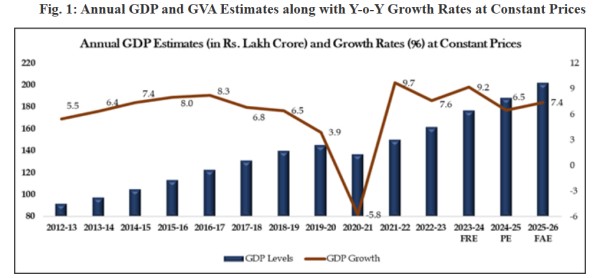
New Delhi: The Indian government has estimated that the country's GDP growth could be 7.4 per cent in the financial year 2025-26 (FY26). This estimate comes at a time when the global economy is slowing down and due to the high tariffs imposed by US President Donald Trump and global uncertainty and geopolitical tensions. Despite this, there are signs of India's economy strengthening. This estimate of the government is slightly higher than the Reserve Bank of India's recent estimate of 7.3% and is considered better than the previous financial year's growth of 6.5%. At the same time, nominal GDP is expected to grow by 8% in FY26, compared to 9.7% in the last financial year.
According to the data, the Indian economy remains strong despite global uncertainty and strict financial conditions. Growth is especially supported by the strengthening of the service sector, increasing investment and targeted government spending. Improvement in industrial production, increased credit flow and deepening market reforms have maintained economic momentum. Due to these reasons, India remains one of the fastest growing large economies in Asia.
During the financial year, the government has given income tax relief for the middle class and cut GST rates on many products from 22 September. Industry experts say that these two steps brought more disposable income to the common people, which supported the demand and reduced the pressure of prices at the retail level.
The reduction in GST has improved the transparency in prices and the affordability of products. With this, consumers increased their dispositional expenses and took forward those purchasing decisions which were postponed due to inflation. Tax relief and indirect tax cuts together supported volume growth in FMCG, consumer durables and service sectors.
The data also shows that Real Gross Value Added (GVA) is projected to grow by 7.3% in FY26 from 6.4% in FY25. At the same time, the growth of nominal GVA is expected to be 7.7% in FY26, compared to 9.3% in the last financial year. Overall, the figures indicate that despite external pressures, India's economic foundation remains strong and the growth trend is positive.


Key Highlights
The government data mentioned that Financial, Real Estate & Professional Services and Public Administration, Defence & Other Services in the Tertiary Sector are projected to attain a substantial growth rate of 9.9% at Constant Prices in FY 2025-26.
Transport, Communication & Services Trade, Hotels, related to Broadcasting Sector has been estimated to grow by 7.5% at Constant Prices in FY 2025-26.
Manufacturing and Construction in the Secondary Sector has been estimated to achieve a growth rate of 7.0% at Constant Prices in FY 2025-26.
Agriculture & Allied Sector (3.1%) and Electricity, Gas, Water Supply & Other Utility Services Sector (2.1%) have seen moderate growth rate in GVA at Constant Prices during FY 2025-26.
(Inputs taken from PIB)