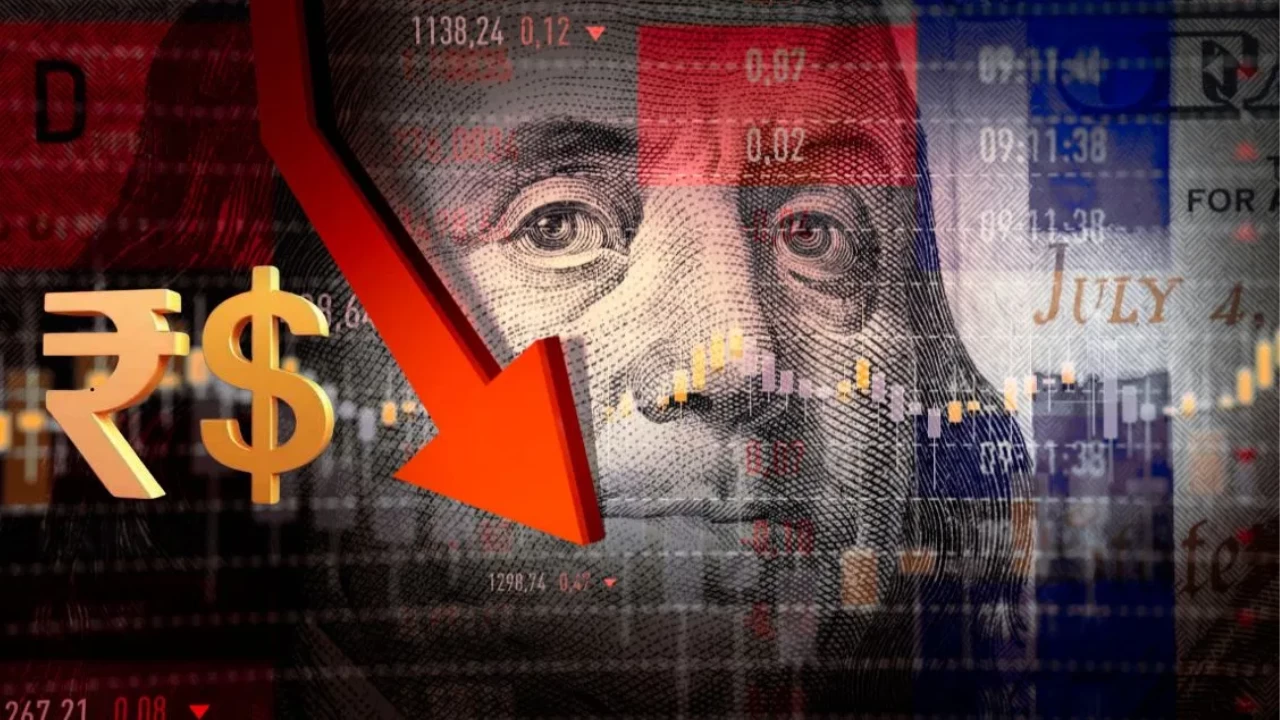
New Delhi: On December 3, 2025 the
Indian Rupee reached a record low of 90.14 against the US dollar in initial trading. This is the third time in recent days when the Rupee touched this much low. The main reason for this is the outflow of FPI, the lack of clearances regarding the India-US trade deal and the weakness of the rupee at the previous important levels, which are increasing pressure on the Indian currency. Today, for the first time, the Rupee has crossed 90 against the dollar. Experts believe that various pressures are acting on the Rupee, including FPI outflow, lack of clarity on India-US trade deals and weakness at the last important level, increasing pressure on the Indian currency, due to which investors' sentiment remains weak.
- In the year 2020 (Covid year), the Rupee weakened to 75.39 per dollar due to uncertainty and capital outflows. Which was near 72-73 in 2019.
- In 2022, the Federal Reserve's aggressive rate hikes and global uncertainty pushed INR to 82.86.
- In the year 2023, the rupee remained under pressure but remained stable, trading in the range of 81—83.
- In the year 2024, despite global challenges, the rupee reached 82.78 per dollar.
- In the year 2025, in the first half of the year, it rotated between INR 82.80—83.60, which crossed Rs 90 by December 2025.
Source-TradingView
Key Factors Affecting USD/INR
There are many factors involved. In which interest rates, inflation rates, government debt, trade balance and terms of trade, global economic chain, dollar demand of the banking system, currency needs of importers and exporters are important.
Rupee against Asian currency
Japanese Yen (JPY)
In 2020, the level of USD/JPY was ~ 101—103 JPY per USD. In 2025, USD/JPY is ~ 155—156 JPY per USD. That is, the yen has seen a very drastic decline. There was a decline of about 50-55 percent.
Chinese Yuan (CNY)
According to recent data for 2025, USD/CNY is ≈ 7.06—7.07. However, between 2018-2022, China has tried to keep its currency more stable, which did not lead to a drop as big as YEN or Rupiah.
Indonesian Rupiah (IDR)
In 2020, Rupiah was under a lot of pressure due to the pandemic and global economic stress. Rupiah stabilized a bit in 2023-2024, but by 2025 it was under pressure. Where in 2015 was 1 dollar ≈ Rp 13,391, in 2025 it was 1 dollar ≈ Rp ~ 16,300—16,623.90. Overall, Rupiah's strength/weakness has fluctuated. But not as bad as JPY.
In 2020—2025, some Asian currencies such as the rupee and the Indonesian rupee saw a significant decline against the US dollar. Meaning the dollar strengthened or their currencies weakened. On the other hand, some currencies such as China's yuan remained comparatively more stable. The Japanese yen recorded a lot of decline during this period.
Who benefits from the weakening of Rupee?
Exporting companies get the biggest benefit when the rupee weakens. Because they get paid in dollars, when converted into rupees, the revenue increases. Such sectors include IT companies (TCS, Infosys, Wipro), pharma exporters, textile and garments, chemical exporters, and auto exporters. These companies may see a rise in margins and profits.
Who loses due to the weakening of the rupee?
At the same time, companies dependent on imports suffer the most due to the weakening of the rupee. They have to pay a higher price in dollars, which increases costs and reduces profits. Affected sectors include oil companies (OMCs), airlines, electronics and mobile importers, capital goods/machinery importing companies, and jewellery companies importing gold. Even for the general public, petrol-diesel, electronics and foreign travel become expensive.
When the rupee weakens, India's goods become cheaper for the world. Foreigners buy more. This gives companies more profit. Exports in the country are increasing. That is why countries like China and Japan kept their currency weak for years.
RBI sold dollars
In 2025, it was reported that RBI sold dollars. So that “excessive” fall in the rupee can be prevented. In August 2025, according to media reports, RBI had sold about $7.7 billion. This step was to prevent volatility in the rupee.