Sign In
By signing in or creating an account, you agree with Associated Broadcasting Company's Terms & Conditions and Privacy Policy.
By signing in or creating an account, you agree with Associated Broadcasting Company's Terms & Conditions and Privacy Policy.


New Delhi: Prime Minister Narendra Modi on Sunday said that the true history of hatred, atrocity and terror linked to repeated attacks on the Somnath Temple had been concealed for decades, asserting that attempts were made after Independence to make people forget this chapter of India's past.
Addressing the Somnath Swabhiman Parv in Gujarat's Gir Somnath district, PM Modi said forces that had opposed the rebuilding of the Somnath temple in the past "are still present among us". He said the temple was not attacked merely for wealth, arguing that if that were the case, a single attack would have sufficed. "It was attacked repeatedly and its deity was desecrated," he said.

Referring to the attack on the temple 1,000 years ago, the Prime Minister said those involved in appeasement had "knelt before religious extremism". He added that Somnath's history was wrongly portrayed as a tale of defeat. "Somnath's history is not of destruction, but of victory and reconstruction," he said, describing it as a symbol of the resilience of Indian civilisation.
Modi said that after Independence, when Sardar Vallabhbhai Patel resolved to rebuild the Somnath temple, his path was obstructed. "There was an attempt to erase this history from public memory," he said, crediting Patel's intervention for the restoration of the temple, which was reopened to devotees in 1951.
Drawing a historical arc, the Prime Minister said religious fundamentalist invaders, from Ghazni to Aurangzeb, believed they had "won" Somnath through force. "This is the cycle of time. Those invaders are now confined to the pages of history, but Somnath still stands tall," he said, adding that the temple's 1,000-year-long struggle had no parallel in world history.
PM Modi said Somnath's story mirrored that of India itself. "Foreign invaders tried to destroy India many times, just as they tried to destroy this temple, but they failed," he said, calling the Somnath Swabhiman Parv a celebration of India's existence and pride. He noted that even after a millennium, the flag of Somnath continues to fly high.
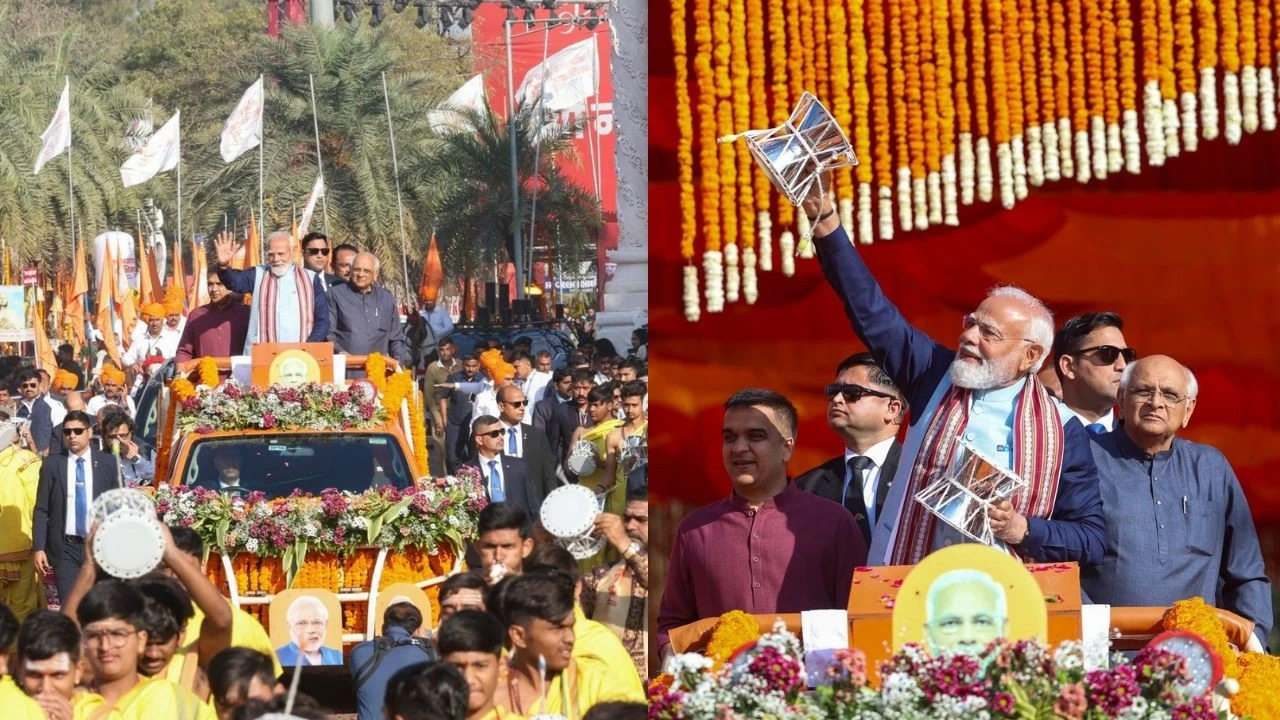
Earlier in the day, the PM led the 'Shaurya Yatra', a ceremonial procession organised to honour those who laid down their lives defending the Somnath temple. The procession, held as part of the Swabhiman Parv, featured 108 horses symbolising valour and sacrifice.
Standing on a specially designed vehicle, the Prime Minister, accompanied by Gujarat chief minister Bhupendra Patel, greeted crowds gathered along the one-kilometre route from Shankh Circle to Veer Hamirji Gohil Circle. Young priests walked alongside playing damru, and artists from several states, including Jammu and Kashmir, performed traditional dances en route.
The yatra culminated at Veer Hamirji Gohil Circle, where PM Modi paid floral tributes to Hamirji Gohil, who sacrificed his life defending the temple against the Delhi Sultanate's army in 1299 AD. He later offered tributes to Sardar Patel near the temple premises and performed a puja at the shrine amid Vedic chants.