Sign In
By signing in or creating an account, you agree with Associated Broadcasting Company's Terms & Conditions and Privacy Policy.
By signing in or creating an account, you agree with Associated Broadcasting Company's Terms & Conditions and Privacy Policy.



The conventional theory for the emergence of life on Earth is that self-sustaining chemical cycles emerged in alkaline hydrothermal vents or a 'warm little pond', paving the way for genetic polymers such as DNA and RNA that can store hereditary information for self-replicating lifeforms. Essentially, this paradigm for life relies on a terrestrial surface at just the right distance from the host star for liquid water to exist on the surface. Volcanism, lightning storms, meteoric impacts, seasons and tides have all been pinpointed at various times as necessary conditions for the emergence of life. These findings are being challenged by what scientists are discovering from asteroids and circumstellar discs.
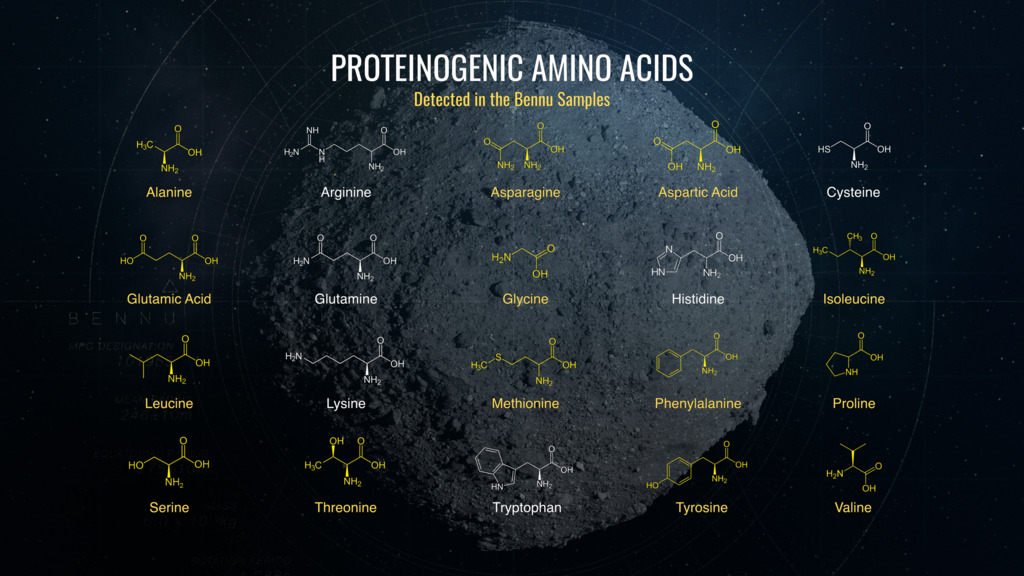
14 of the 20 amino acids used by life on Earth to build proteins have been discovered on Bennu. (Image Credit: NASA Goddard/OSIRIS-REx).
Three new papers based on analysis of the samples returned from asteroid Bennu by NASA's OSIRIS-REx mission indicate that the asteroid was enriched in dust from the violent deaths of ancient stars, all the chemical ingredients necessary to form RNA, as well as a mysterious new gelatinous substance never before seen in any astromaterial, dubbed 'space gum'. While the sugar ribose necessary for making ribonucleic acid (RNA) has been discovered on Bennu, deoxyribose necessary for making deoxyribonucleic acid (DNA) was not, supporting the RNA World hypothesis, where primitive life was dominated by RNA, which served as both the storage for genetic information as DNA does, and as enzymes that promote self-replication like proteins do.
The RNA World hypothesis describes the emergence of life on Earth. The discovery of ribose in the Bennu samples is not surprising, as ribose has previously been discovered in meteors. The chemical ingredients necessary to build RNA along with various other precursors of life have also been discovered in circumstellar discs of newborn stars. There is an increasing buildup of evidence to indicate that the ingredients necessary for life were readily available on all asteroids across the Solar System. The discovery of similar chemical inventories around distant newborn stars also support framing life as an astrophysical process as against a geochemical one.

Bio-essential sugars discovered on Bennu. (Image Credit: NASA/Goddard/University of Arizona/Dan Gallagher).
Bennu is the fragment of a long-lost world. In the infancy of the Solar System, the conditions were warm enough for even smaller asteroids, as small as 200 km wide to develop differentiated interiors, with the heavier elements sinking towards the core. Bennu might have been one of many worlds with liquid water on the surface, where the chemical processes leading up to life were ongoing. Water, along with the ingredients necessary for life could have been delivered to the Earth by asteroids soon after its formation, allowing for life to emerge on the Earth. The origins of life would be in the circumstellar disks surrounding embryonic stars, with complex organic chemistry emerging from the interplay between gases, ices and dust.