Sign In
By signing in or creating an account, you agree with Associated Broadcasting Company's Terms & Conditions and Privacy Policy.
By signing in or creating an account, you agree with Associated Broadcasting Company's Terms & Conditions and Privacy Policy.
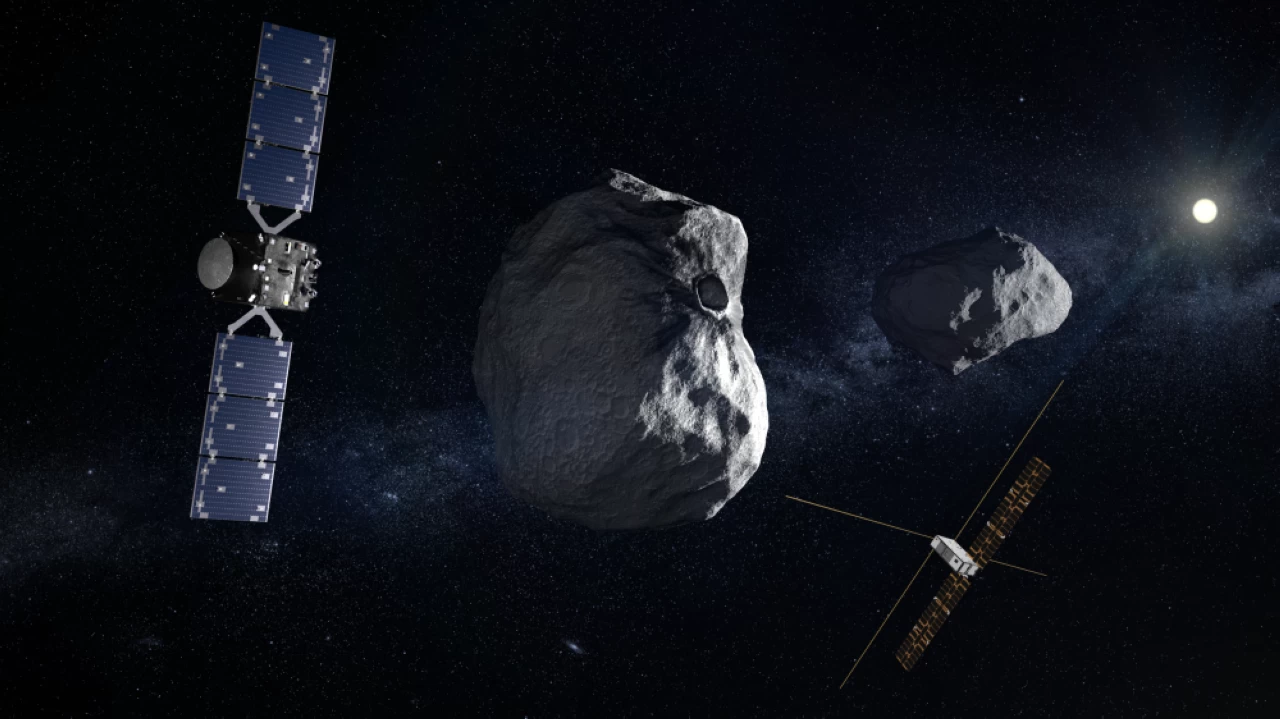


On 26 September, 2022, NASA’s Double Asteroid Redirection Test (DART) spacecraft collided with the asteroid Dimorphos to deflect it. Dimorphos is a 160 metre wide moonlet in orbit around the 780 metre wide asteroid Didymos. The DART kinetic impactor rammed into the moonlet at 6.6 kilometres per second in humanity’s first attempt at deflecting an asteroid. A moonlet was chosen for the mission as it had a well-understood orbit, and measuring the deflection on an asteroid orbiting the Earth was not feasible. The DART mission was a demonstration of using a kinetic impactor as a planetary defence strategy.
The results were in excess of what the scientists had expected when planning the mission. The orbit of Dimorphos around Didymos reduced by 33 minutes, 25 times greater than predicted. Dimorphos is a rubble pile asteroid, with the loose material held together by the tenuous grip of low gravity. This internal structure amplified the effect of the impact. The European Space Agency (ESA) launched a follow-up mission, Hera to better understand the consequences of the impact test. Hera was launched on a SpaceX Falcon 9 from Cape Canaveral in Florida, USA on 7 October, 2024, and is en route to the Didymos system.
On 12 March, 2025, the Hera mission executed a flyby of Mars and its moon Diemos, on the way to the Didymos system. The spacecraft is expected to reach its target in December 2026, after a trip of two years. The goal of the mission is to examine the aftermath of the DART impact, so that humans can refine asteroid deflection techniques, and better understand our understanding of binary asteroid systems. Hera is the second act of the Asteroid Impact and Deflection Assessment (AIDA) collaboration between ESA and NASA.
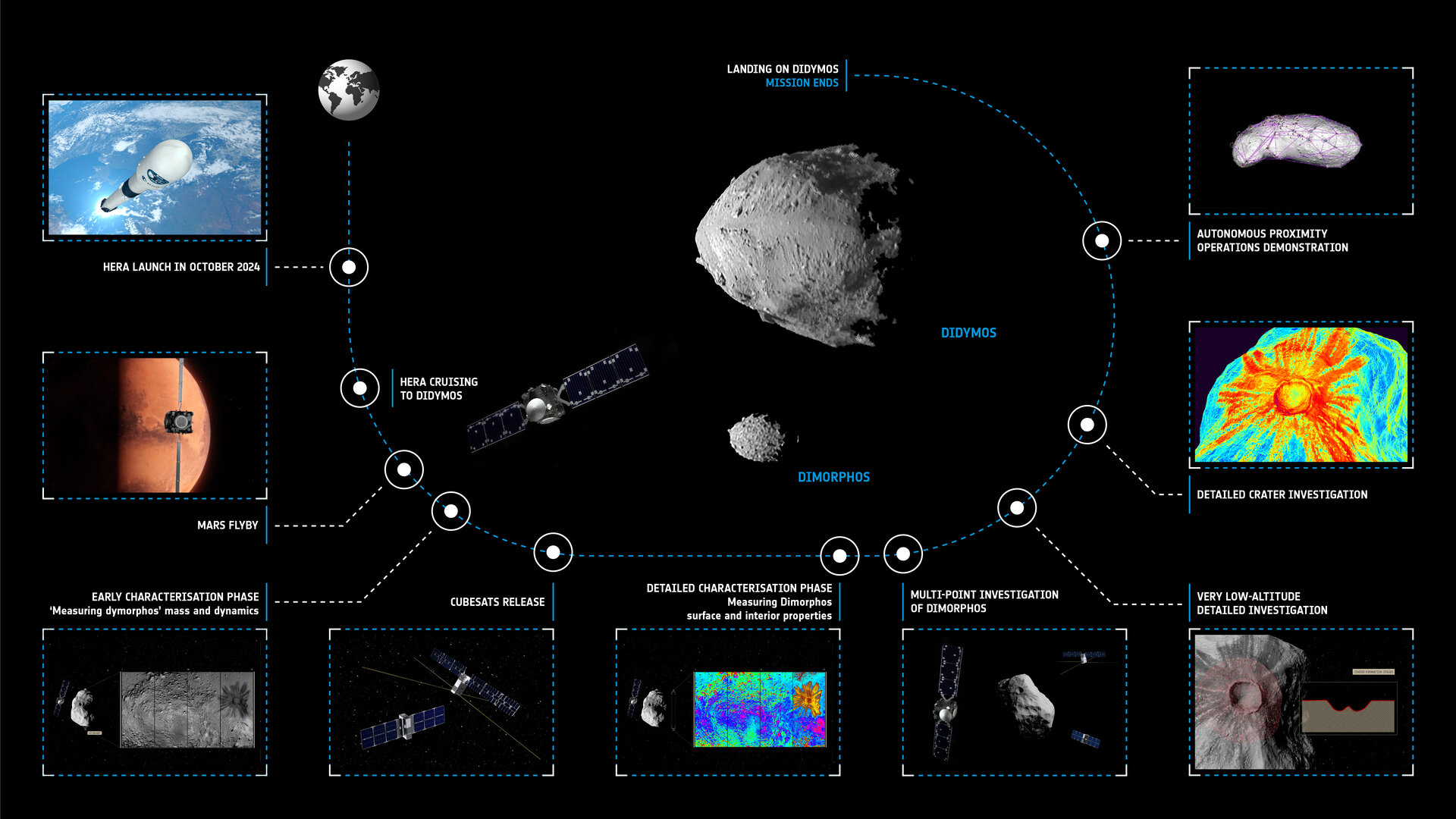
Timeline of the Hera mission. (Image Credit: ESA).
Dimorphos is roughly the size of the great pyramid, and was an ideal target for the asteroid deflection test, small enough to be deflected by a van-sized spacecraft, and representative of near-Earth objects (NEOs) that can one day threaten the Earth. The impact by DART ejected over a million kilograms of debris, forming a tail that was visible from Earth-based telescopes. The impact is likely to have entirely reshaped Dimorphos. Initial models predicted the formation of a crater 20 metres wide, but the extent of the orbital change indicates that the crater could be larger, perhaps 50 metres wide. The shape of the moonlet may have changed significantly, which is what Hera is out to discover.
Hera is a cubic spacecraft measuring 1.6 metres across with five metre solar panels, packed with a hyperspectral imager, a laser altimeter, and a thermal infrared camera. These instruments allows the spacecraft to map the asteroid at a sub-millimeter level. The depths of craters, the height of rims and the porosity of the surface can all be measured using the sophisticated suite of instruments. Two small CubeSats are accompanying Hera, named Milani and Juventus. These cubesats will attempt to understand if the low gravity, or porosity helped amplify the recoil from the ejecta.
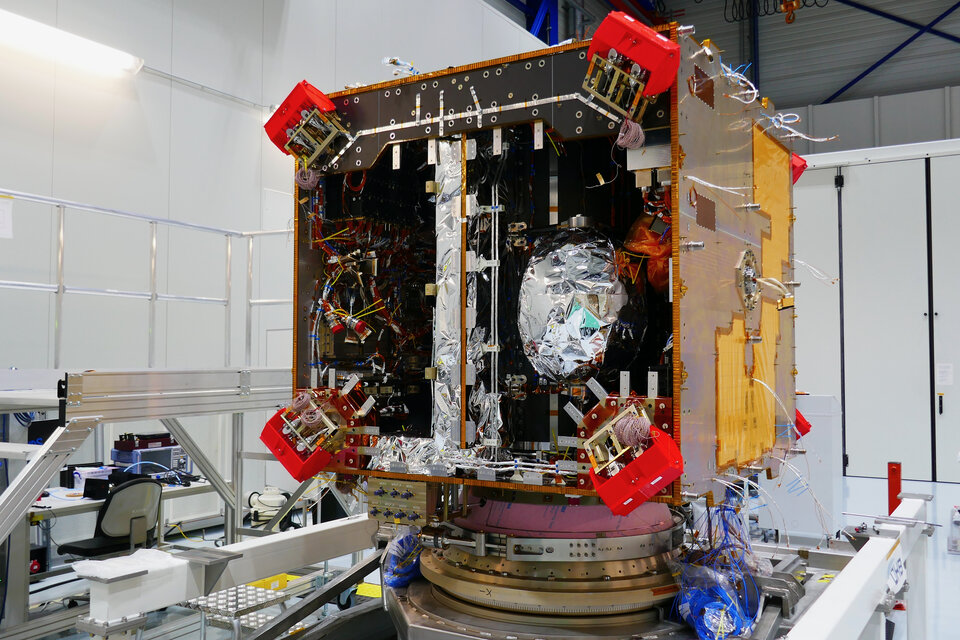
The Hera spacecraft. (Image Credit: ESA).
Milani is loaded with a near-infrared spectrometer to analyse the mineral composition of Dimorphos. This instrument can determine if the asteroid contains silicates, hydrated clays or organic compounds, while investigating the dust cloud ejected by the DART impact. Juventus will be the first spacecraft to probe an asteroid with a low-frequency radar, to investigate the remote interior of Dimorphos, revealing its density and structural cohesion. These measurements will help scientists calculate the mass of the asteroid and the moment of inertia, which are both important for understanding the amount of momentum that DART managed to transfer, and why the deflection exceeded expectations. The data will help scientists refine impact models for asteroids ranging from the shattered cores of differentiated worlds, to fragile rubble piles.
The trajectory that Hera is taking to Dimorphos requires precise planning and operations. After launch, Hera executed a pair of deep-space burns to align itself for a March flyby. The spacecraft slightly slowed down the rotation of Mars, stealing the energy to slingshot towards Didymos, cutting down on the travel time and fuel cost. The ground teams used the flyby to capture high-resolution images of Mars and Deimos, calibrating the instruments on board against known targets.
Once Hera arrives at Didymos, it will enter into orbit, gradually reducing its altitude from 70 kilometres down to 200 metres. On board AI will autonomously navigate the spacecraft to dodge debris and boulders. Hera will then deploy Milani and Juventas that will approach Dimorphos and eventually land, capturing high-resolution data and transmitting observations using a unique inter-satellite link. The Hera mission is expected to provide a bonanza of scientific data.