Sign In
By signing in or creating an account, you agree with Associated Broadcasting Company's Terms & Conditions and Privacy Policy.
By signing in or creating an account, you agree with Associated Broadcasting Company's Terms & Conditions and Privacy Policy.
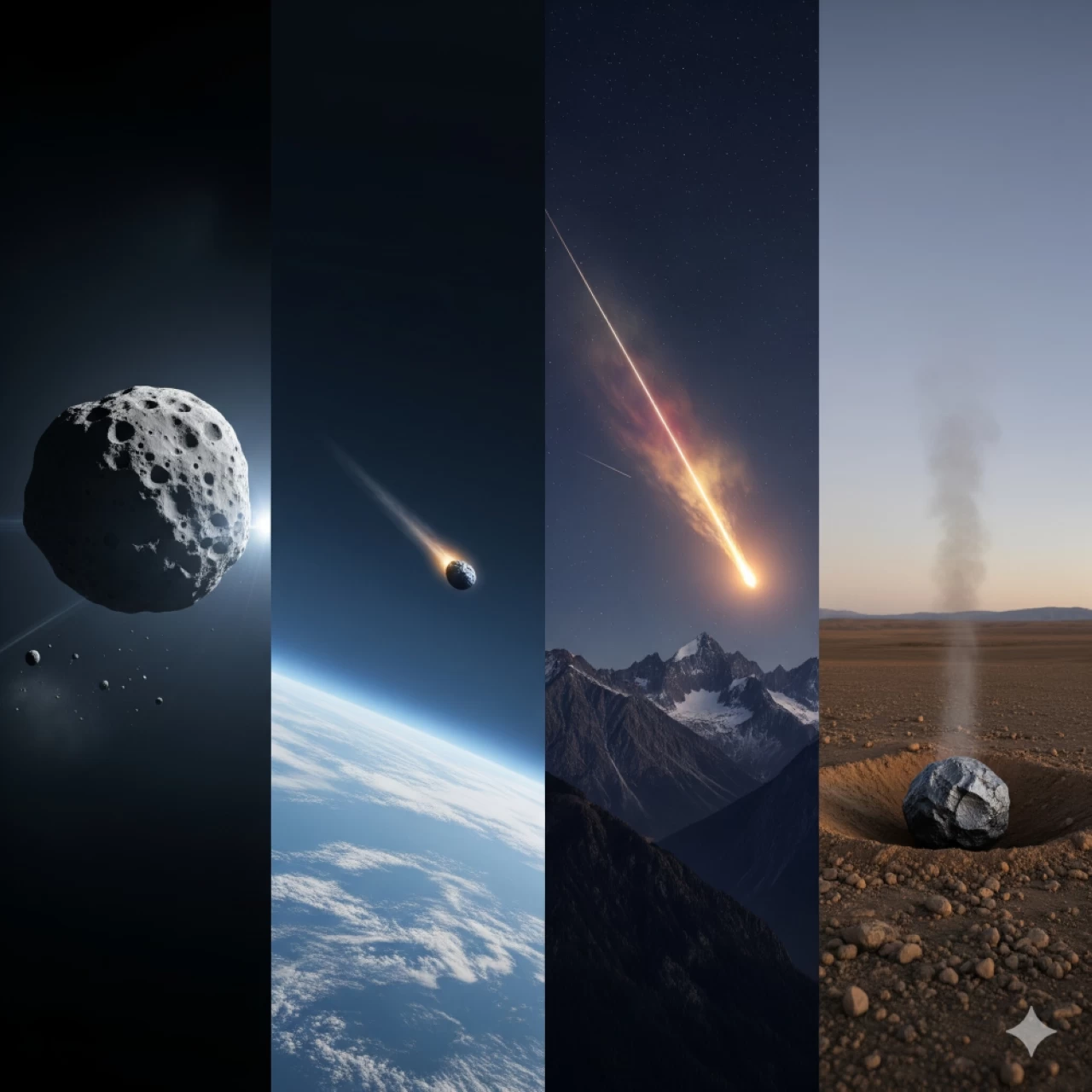


Asteroids are debris from the infancy of the Solar System, rocky, airless bodies that orbit the Sun. Asteroids range in size from one metre to 1,000 kilometres across. After reaching about 400 kilometres in size, asteroids start assuming a spherical shape. Ceres, measuring 947 metres across, is the largest asteroid in the Solar System, and is nearly a protoplanet. Most of the asteroids are found in the main belt between Mars and Jupiter, and are composed of rock, metal or carbon. Asteroids reflect sunlight, and can be objects with a homogenous bulk or a loosely held together pile of rubble.
The very smallest asteroids are called meteoroids, that can be a metre across at most. Meteors are cosmic debris entering the atmosphere of the Earth and burning up from friction. Meteors can be fragments of asteroids, cometary dust, or lunar ejecta. If a meteoroid survives the trip through the atmosphere and reaches the ground, it is called a meteorite. Unlike asteroids, that are defined by their orbits and composition, meteorites are defined by how they react with the atmosphere of the Earth. A simple explanation is that asteroids are rocks in space, meteoroids are fragments of rocks in space, meteors are sparks in the sky and meteorites are meteors that reach the surface of the Earth.
Yes asteroids can become meteorites, but have to follow certain steps in the journey. Asteroids mostly reside in the main belt between Mars and Jupiter, and orbit the Sun. Collisions or gravitational nudges from planets such as Jupiter can knock fragments loose. The smallest fragments, less than a meter across are called meteoroids, These may drift towards the Earth. On entering the atmosphere of the Earth, they become meteors, glowing in the extreme friction caused by the atmosphere of the Earth.
Most meteors disintegrate completely, but some reach the ground in the form of meteorite. At times, an asteroid may not directly become a meteorite, but the smaller, fragmented chunks from the parent body do. The Chelyabinsk event in 2013 involved a 20-metre asteroid that exploded in mid-air, raining down a shower of meteorites. Asteroids are the source or the parent bodies, meteoroids are the children, meteors are a light show and meteorites are the survivors.
The difference between a meteor and an asteroid is not about size, and they are distinct phenomena. The terms hinge on the related concepts of meteoroids and asteroids. When a meteoroid enters the atmosphere, it burns up in a streak of light known as a meteor. Asteroids are larger, rocky objects orbiting the Sun. The size cutoff between meteoroids and asteroids is fuzzy, but conventionally pegged at one meter by astronomers. Context matters as well, even a two metre rock in space is an asteroid, till it strikes the atmosphere of the Earth, at which point it becomes a meteor.

The 500 kg Tamentit meteorite discovered in the Sahara in 1864. (Image Credit: Ji-Elle/Wikipedia).
If the object survives the trip through the atmosphere, it becomes a meteorite. The size of the fragment dictates its behaviour in the atmosphere. Smaller meteoroids vapourise, while larger ones, over 10 metres across can explode in the form of an airburst, as seen with the Chelyabinsk event. A meteor can only become an asteroid if once landing on a terrestrial surface with a thick atmosphere, the planetary body is subsequently battered to bits. It is safe to say that a meteor never becomes an asteroid. Rather, the size of the asteroid decides whether it becomes a meteorite or ends up as a meteor.
The Chicxulub impactor was a comet or an asteroid, a massive object estimated to measure between 10 and 15 kilometres across, slamming into the Earth in the Yucatan Peninsula. This object was likely from the asteroid belt. The impact created debris, including meteorite fragments, but the bulk of the asteroid survived the trip through the atmosphere, without experiencing the extreme friction. The impact triggered global wildfires, tsunamis, and a dust driven impact winter.
75 per cent of all species on Earth, including non-avian dinosaurs were wiped out by the impact. However, an increasing amount of evidence indicates that the mass extinction was not caused by the asteroid impact at all. Four of the five mass extinctions on Earth were driven by excessive volcanism. An increasing number of scientists believe that the extinction of the dinosaurs was primarily driven by the extreme volcanoes that formed the Deccan Traps in India. The Chicxulub impactor may have just provided the finishing blow.