Sign In
By signing in or creating an account, you agree with Associated Broadcasting Company's Terms & Conditions and Privacy Policy.
By signing in or creating an account, you agree with Associated Broadcasting Company's Terms & Conditions and Privacy Policy.
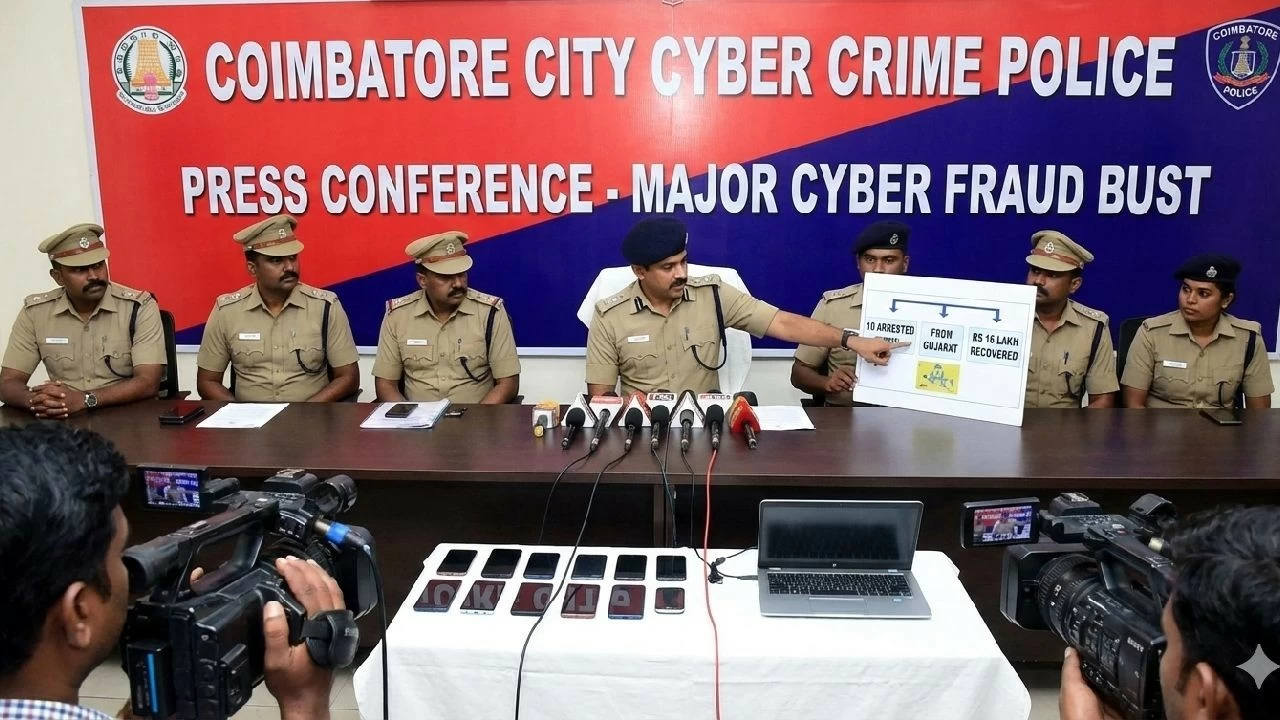


Coimbatore: In a significant crackdown on interstate cyber fraud, the Coimbatore Cyber Crime Police have arrested 10 individuals from Gujarat for allegedly hacking the mobile phone of a 71-year-old man from Goundampalayam and stealing ₹16 lakh from his bank account. The arrests highlight the growing menace of cybercrime, which saw Indians lose a staggering ₹19,812 crore in 2025 alone.
The victim, Samuel Chandrasekhar, received a malicious link two months ago purportedly from the Regional Transport Office (RTO). Upon clicking it, his phone was compromised, leading to the unauthorized withdrawal of ₹16 lakh from his bank account the following day via his credit card.



Interstate Operation
Acting on Chandrasekhar’s complaint, a special police team traced the fraud to a gang operating from Surat, Gujarat. After conducting raids, the team arrested the ten accused, who have been identified as residents of the Surat area. The police recovered ₹3.50 lakh in cash, 311 credit/debit cards, and a swiping machine from the suspects. Additionally, ₹6.39 lakh in their bank accounts has been frozen.
National Cyber Fraud Landscape
The case underscores a alarming national trend. Over the past six years, Indians have lost ₹52,976 crore to online fraud. In 2025, Maharashtra recorded the highest losses at ₹3,203 crore, followed by Karnataka (₹2,413 crore) and Tamil Nadu (₹1,897 crore). Common tactics include phishing calls impersonating bank officials, fraudulent KYC update requests, and deceptive links.
Ongoing Investigation
The Coimbatore police are investigating whether the gang targeted other victims using similar methods. The arrests serve as a warning to cybercriminals exploiting vulnerable citizens, especially the elderly, through increasingly sophisticated digital scams.
Authorities have urged the public to exercise extreme caution with unsolicited links and calls, and to verify directly with their banks before sharing sensitive information.