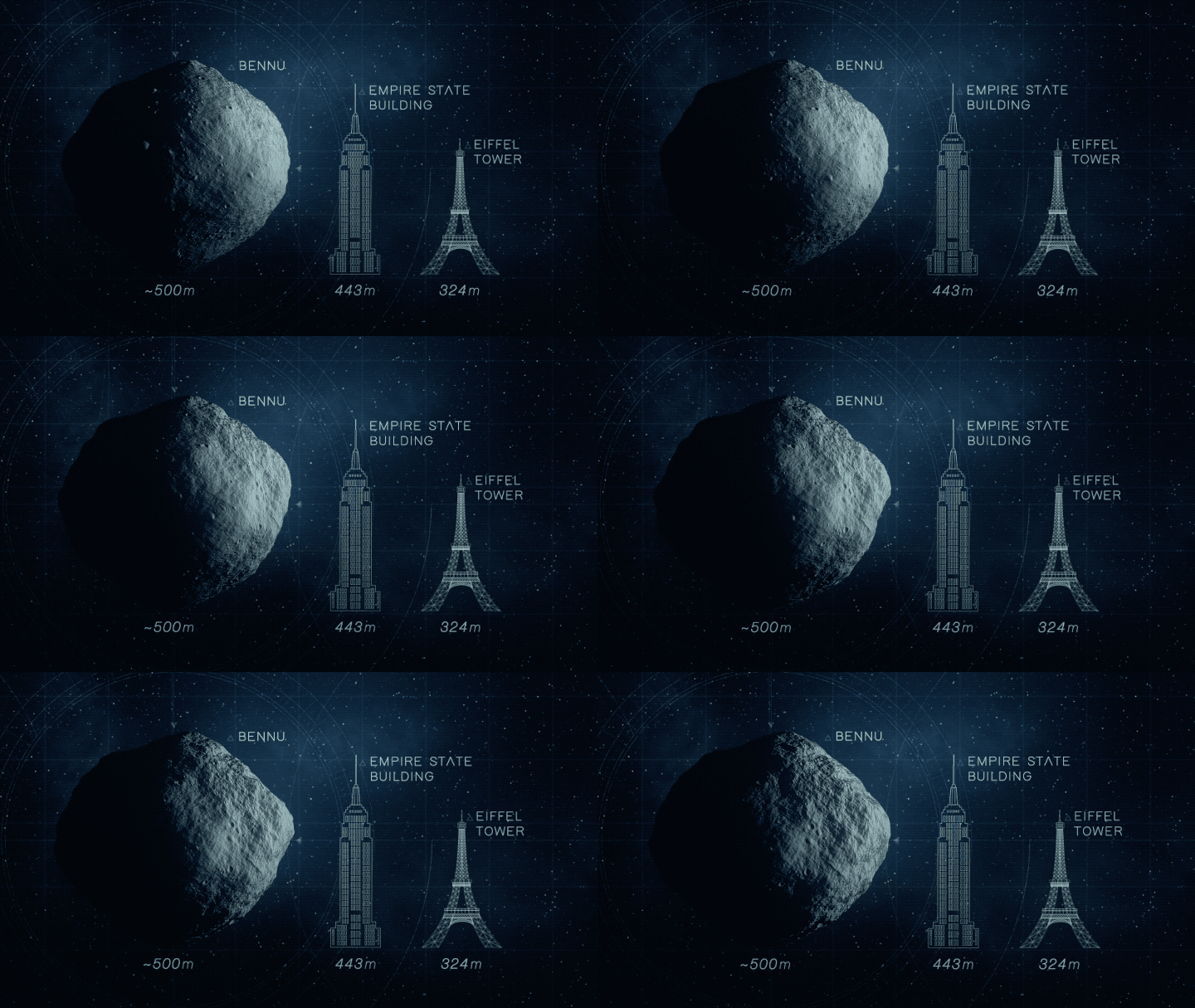
On 11 September, 1999, astronomers at MIT’s Lincoln Laboratory were using a telescope in Socorro, New Mexico for an automated survey of asteroids, called the Lincoln Near-Earth Asteroid Research (LINEAR) project. Initially tagged as 1999 RQ36, the search discovered a 500 metre wide asteroid that orbits the Sun every 1.2 years, and approaches close enough to the Earth to be considered a possible impactor in the distant future, or a Potentially Hazardous Asteroid (PHA).
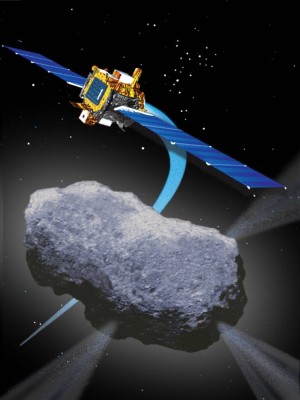
The visualisation is based on actual data captured by the probe. (Image Credit: NASA).
Asteroids are similar to time capsules, made up of the same raw material that assembled into planets. The gravitational tug of war between Jupiter and the Sun prevented the formation of a planet between Mars and Jupiter. Most of the asteroids in the Solar System occupy the main belt between the orbits of Mars and Jupiter. However, Bennu is one of the asteroids that have drifted in closer, into the neighbourhood of the Earth, making it a suitable target for a sample return mission.
The OSIRIS-REx mission
Researchers from the University of Arizona, The Planetary Society and MIT dubbed 1999 RQ36 as 101955 Bennu after confirming its orbit. The asteroid was named in honour of a bird from Egyptian mythology linked to the Sun and rebirth. Planning on the OSIRIS-REx mission was conceptualised in 2000, and was picked in 2011 over competing missions to the Moon and Venus by NASA’s New Frontiers programme. The scientists aimed to return at least 60 grams from Bennu to understand the formation of the Solar System and the origins of life.
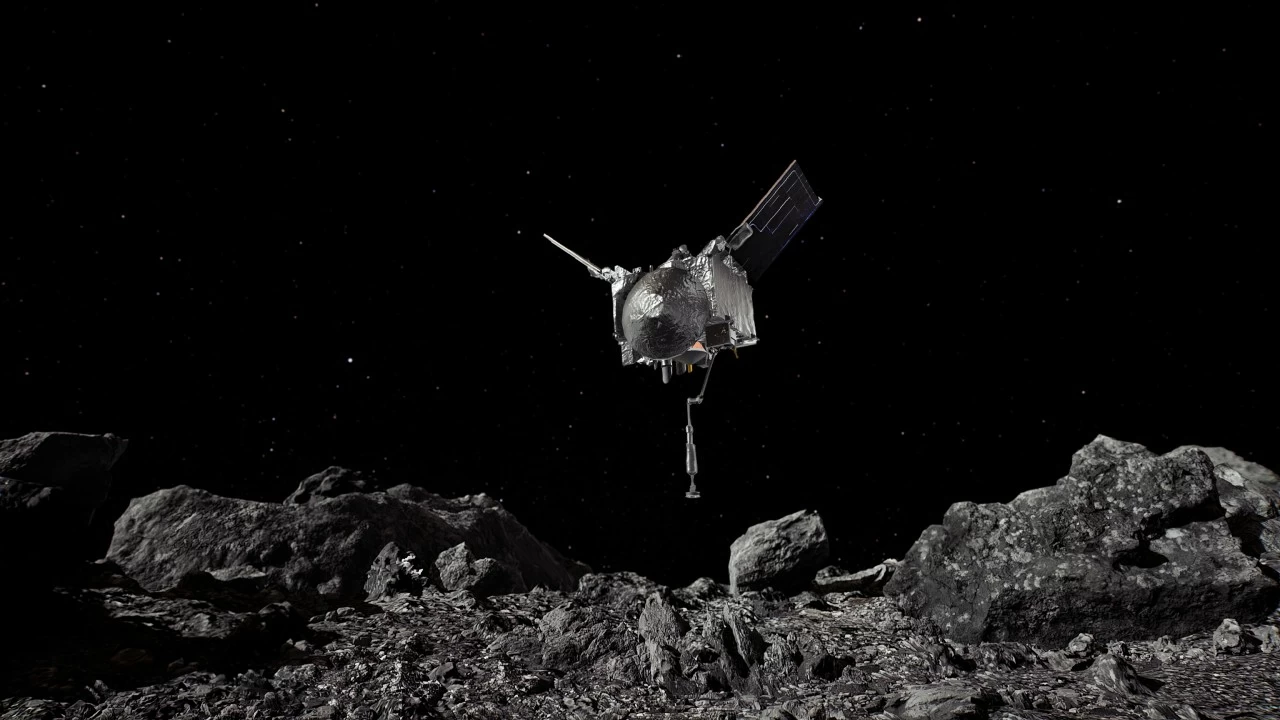
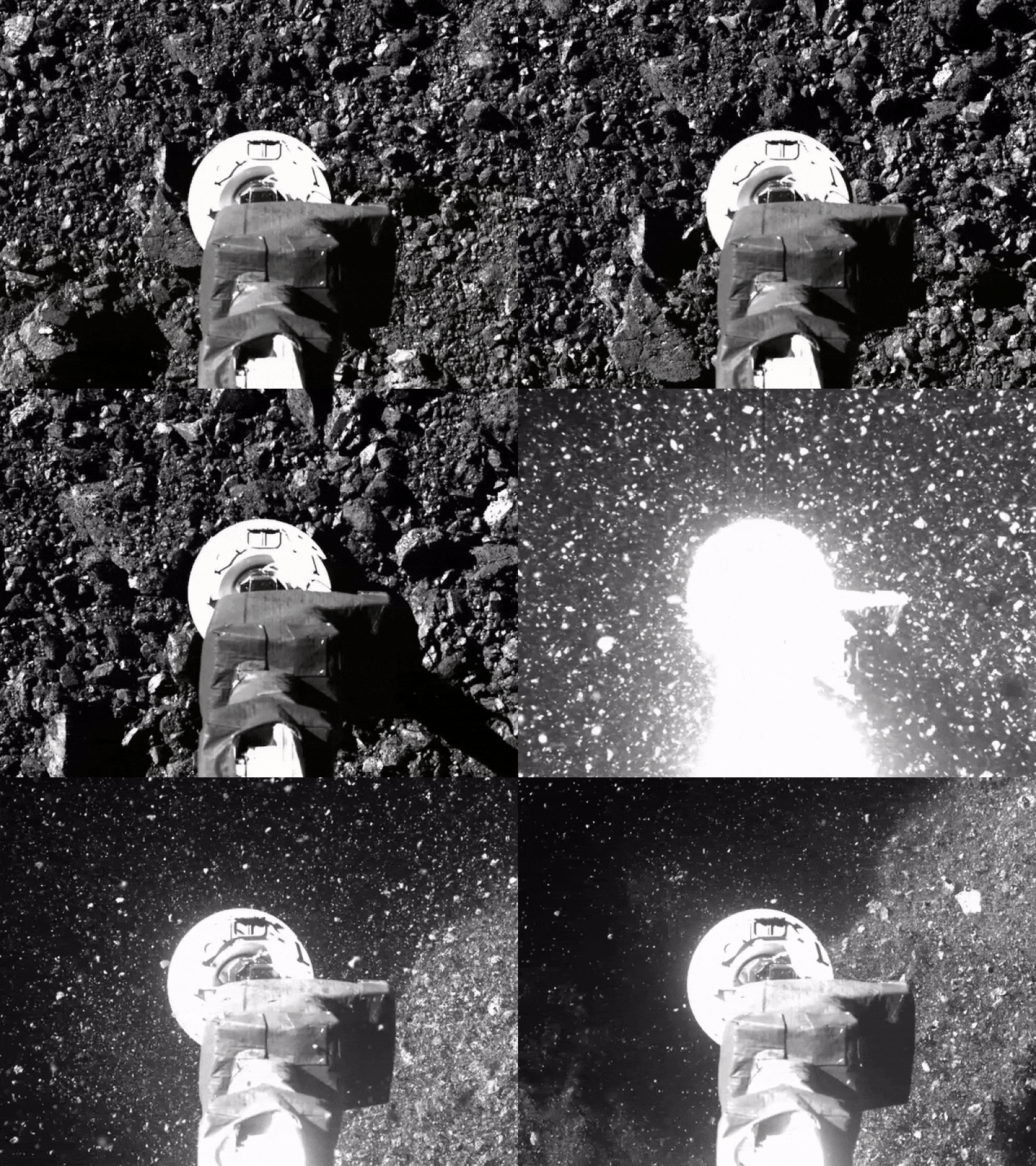
OSIRIS-REx capturing the sample. (Image Credit: NASA).
NASA’s s Origins, Spectral Interpretation, Resource Identification, Security - Regolith Explorer was the first sample return mission by the USA to an asteroid. The OSIRIS-REx spacecraft launched on 8 September, 2016 on top of an Atlas V rocket from the spaceport in Cape Canaveral in Florida, USA. On 3 December 2018, the spacecraft entered into orbit around Bennu, the smallest body to host an artificial satellite. For two years, OSIRIS-REx mapped the boulder-strewn surface of Bennu, revealing it as a pile of rubble without a cohesive bulk, held together by the weak grip of low gravity.
The OSIRIS-REx mission
The mission operators on the ground identified four sampling sites, named after birds found in Egypt, Nightingale, Osprey, Sandpiper and Kingfisher. On 20 October 2020 after rehearsing the manoeuvres, OSIRIS-REx executed a messy touch-and-go operation collecting so much material that the sample collection mechanism got jammed. OSIRIS-REx began its return journey on 10 May, 2021. The spacecraft lobbed the Reentry Capsule towards the Earth, that landed in an Airforce Test and Training Range in Utah on 24 September, 2023. The drogue parachute failed, but the main chute held. A convoy of Jeeps headed out to retrieve the sample, which was whisked by helicopter to a clean room.
Opening the sample container proved to be problematic. There was additional material outside the container as well. Specialised tools were developed to crack open the capsule, to reveal 121.6 grams of material, double the goal of the planned mission. The analysis of the samples revealed a rich history of the Solar System. There were organics rich in carbon and nitrogen, including 14 of the 20 protein-building amino acids, and all the four nucleobases that make up DNA and RNA. There was a near-equal mix of left-handed and right-handed amino acids, which was a surprise as the proteins on Earth are made up almost exclusively of left-handed amino acids. It may have been possible that bodies similar to Bennu seeded biochemistry on a primordial Earth.
Fragment of a Lost World
Bennu is not made up of pristine material from the infancy of the Solar System that never coalesced into a planet. Instead, it was the shattered fragment of a large, watery asteroid. There were clay minerals on Bennu, similar to the rocks on the mid-ocean ridges on the Earth. Unexpected and pure molecules hinted that Bennu was from a primitive ocean world that was battered to bits. Bennu was pegged as a chemically primitive relic, carrying the building-blocks of life.
The samples from Bennu. (Image Credit: NASA).
The composition indicates that it is a fragment of a larger body in the asteroid belt, measuring between 100 and 200 kilometres across, formed about 4.5 billion years ago. There were interactions between water and rock on the asteroid that formed clays and phosphates before it shattered by a cataclysmic impact event. Bennu has a low density, just about twice that of water, and is made out of porous, spongy rock. It is a loose-aggregate. Some researchers suspect that Bennu is not a fragment of a dry, volatile-rich asteroid altered by heat, but a wet dwarf planet.
From Bennu to Apophis
After visiting Bennu and returning to the Earth, OSIRIS-REx did not retire. The spacecraft was renamed OSIRIS-Apex and is now en route to study the asteroid Apophis days after a close
encounter with the Earth on 13 April, 2029. OSIRIS-Apex will reach Apophis on 21 April 2029, and orbit the asteroid for about 18 months, mapping the surface, and attempting to use its thrusters to expose subsurface material. Unlike Bennu, Apophis is not rich in carbons, and will provide a contrasting view of Near-Earth Asteroids.