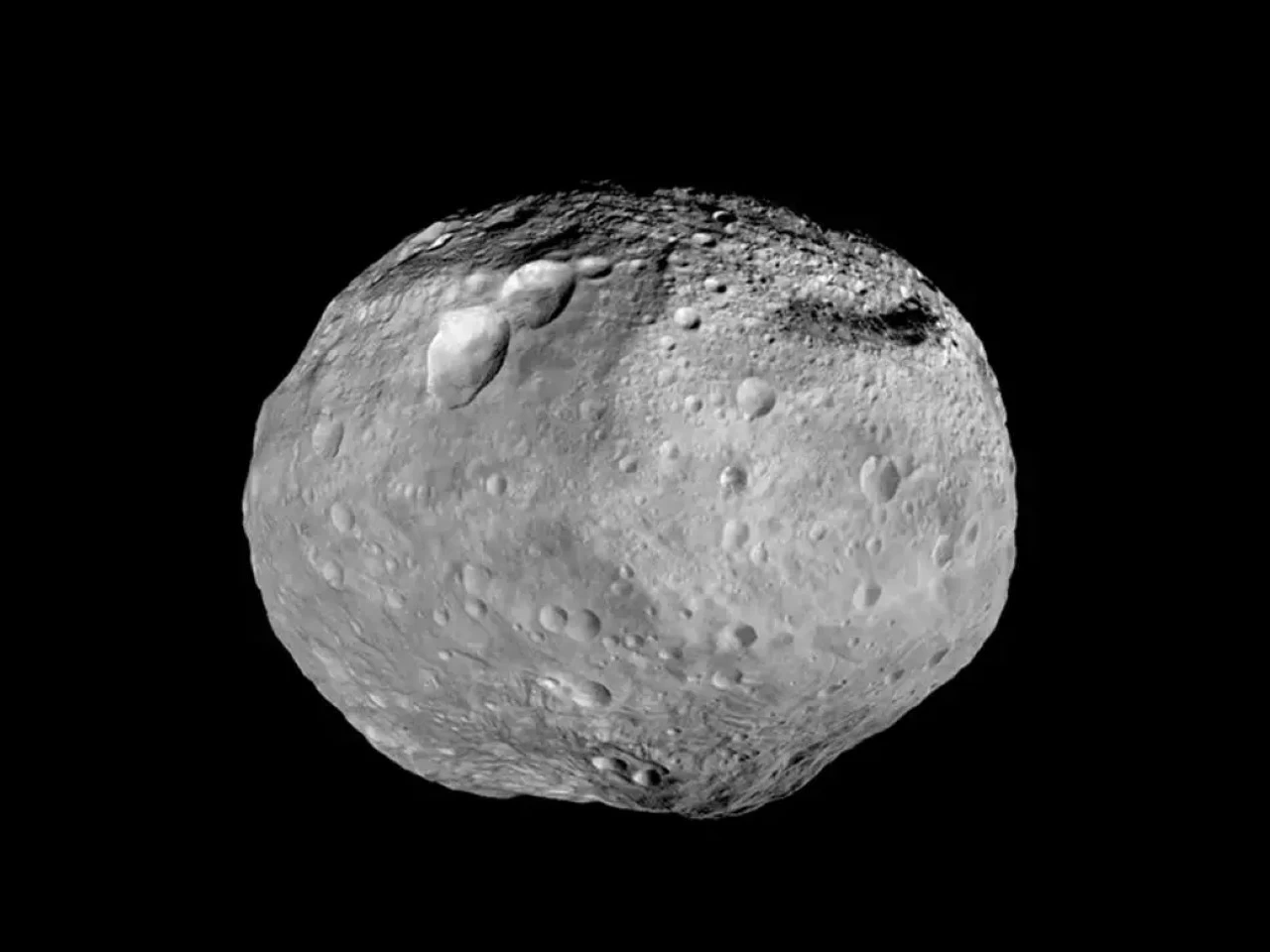
4 Vesta is the second-most massive object in the Main Belt of asteroids between the orbits of Mars and Jupiter. The object spans 525 kilometres in diameter and is a protoplanet, a seed of a world that never germinated, a survivor of the chaotic infancy of the Solar System. The object is a protoplanet and a minor planet but not a dwarf planet, because its differentiated interior had solidified by the time it was battered by other asteroids, and could not regain its spherical shape. This battering occurred in the infancy of the Solar System, scarring the crust. As such Vesta bridges the gap between an asteroid and a planet. While too lumpy to be considered a planet, 4 Vesta is the brightest asteroid ever discovered.
The internal structure of Vesta. (Image Credit: NASA).
Its reflective surface is rich in basaltic rock, indicating a volcanic past, something that is rare among asteroids. Vesta has a differentiated interior, a core, mantle and crust, but unlike that of the Earth, all of these are frozen, solid. The crust and mantle are rocky, but the core is metallic, indicating that the interior was liquid in the past. The growth of this protoplanet was halted by the gravitational influence of Jupiter. The most striking feature on the surface is the Rheasilvia crater, spanning 500 kilometres across, nearly engulfing the entire southern hemisphere. This crater has a central peak that towers 22 kilometres high, and is one of the tallest mountains in the Solar System.
The ambitious Dawn Mission
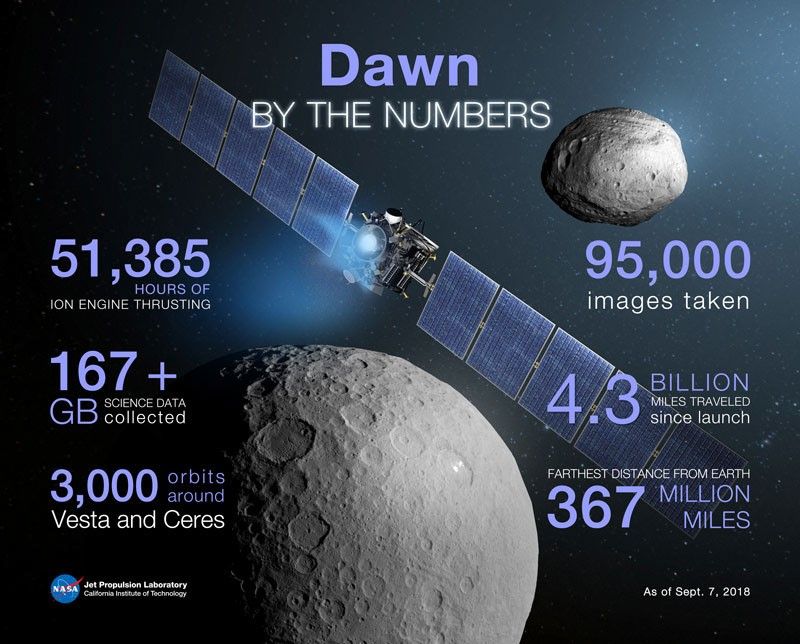
Vesta has a 3.63 year orbit, and is located firmly in the main belt. However, there are fragments of Vesta that have reached the Earth as meteorites. Scientists longed to study this protoplanet from up close. NASa launched the Dawn spacecraft on 27 September, 2007 with the goal of orbiting two asteroids, Vesta and Ceres, using an innovative ion propulsion system. The spacecraft made a gentle and steady journey to the asteroid belt, crossing 2.8 billion kilometres over a period of four years, in a mostly quiet cruise punctuated by a gravity assist from Mars. Dawn reached Vesta on July 15, 2011, and became the first spacecraft to enter into orbit around a Main Belt object.
Dawn infographic. (Image Credit: NASA).
The ion engines on Vesta decelerated the spacecraft to match the orbit on Vesta. The spacecraft beamed back images revealing a rugged world with dark streaks and a massive scar spanning the southern hemisphere. This was the 500 metre wide Rheasilvia crater. The scientists were stunned by the scale of the feature. Dawn settled into orbit around Vesta revealing a triaxial shape and a mottled surface with mysterious dark patches. The instruments on board were able to confirm that the surface was covered by volcanic rock, that only occurs on bodies where igneous magma leaks onto the surface from a molten interior, through a volcano.
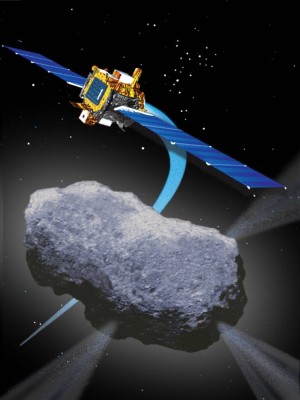
Illustration of Dawn. (Image Credit: NASA).
Over the course of four months, Dawn mapped 80 per cent of the interior of Vesta, revealing a 13 kilometre wide trio of craters dubbed the ‘Snowman’. The spacecraft approached even closer to the asteroid, revealing the interior. The core of Vesta was pegged at 110 kilometres wide. On 25 July, Dawn began its departure, escaping the gravitational influence of Vesta on 4 September 2012, after exploring Vesta for 14 months. Dawn captured 31,000 images and 20 million spectral readings of Vesta, along with a gravity map. About one per cent of the mass of Vesta was ejected by the impact crater formed one billion years ago, by an object measuring 50 kilometres across. The fragments from this impact occasionally rain down on the Earth. The shockwave from the impact fractured the surface, creating grooves. Vesta is dry today, but contains hydrated minerals, hinting at a wetter past.
The discovery of Vesta
In the early 19th century, the architecture of the Solar System was not fully understood. Uranus had been discovered in 1781, and Neptune would be discovered only midway into the century. A subsequently debunked mathematical curiosity called the Titius-Bode law predicted a missing planet between the orbits of Mars and Jupiter. Across Europe, a loose-knit group of astronomers led by Johann Elert Bode had formed the
Celestial Police and were combing the asteroid belt. On 1 January 1801, the Italian astronomer Giuseppe Piazzi discovered Ceres in the asteroid belt, but was cautious to call it a planet. This minor planet was the first asteroid to be discovered.
The 'Snowman'. (Image Credit: NASA).
The discovery of Ceres spurred further interest in the region. Heinrich Wilhelm Olbers was an active member of the Celestial Police, and had discovered 2 Pallas, the second known asteroid on 28 March 1802. By 1807, he was methodically scanning the skies, convinced that there were more objects in the gap between mars and Jupiter. On 29 March 1807, Olbers discovered a faint object that appeared to be moving from night to night. It was brighter than Ceres or Pallas, and was visible to the naked eye if the skies were sufficiently dark. Olbers shared his observations with another member of the Celestial Police, Carl Friedrich Gauss, a mathematical prodigy who refined the orbit of Ceres, allowing Olbers to announce his find and dub the asteroid Vesta. This tradition continues to this day, and if you discover an asteroid, you get to name it.