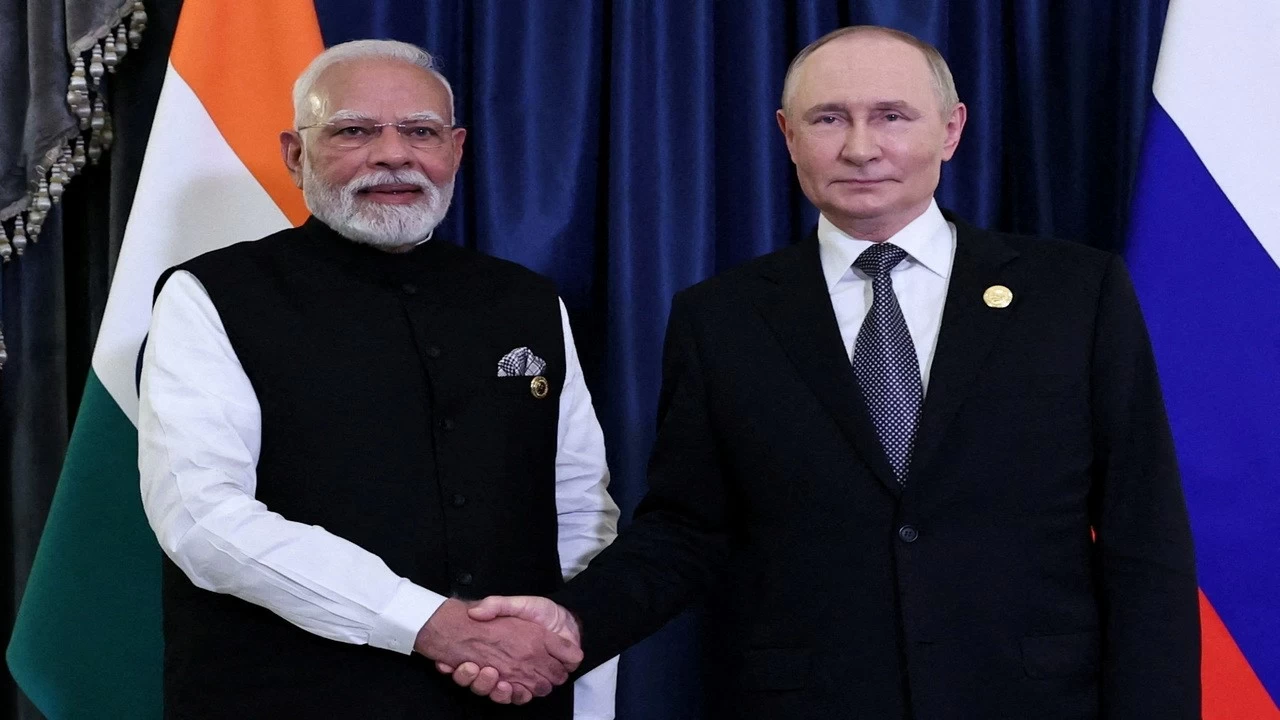
New Delhi: Russian President Vladimir Putin will travel to New Delhi on December 4–5 for the annual India–Russia summit. During the visit, he will hold
bilateral talks with Prime Minister Narendra Modi, who had attended last year’s summit in Russia. During the visit, the Russian President Vladimir Putin and Indian Prime Minister Narendra Modi are set to discuss a spate of issues, which include everything from a labour mobility pact to the supply of S-400 air defence systems to India.
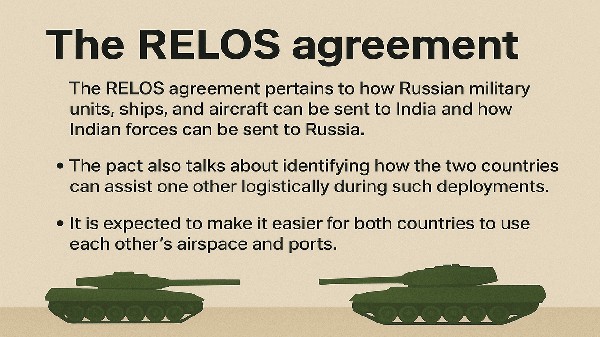
The RELOS agreement
A major defence pact that looks to be finalised during President Putin’s India visit is the RELOS agreement. Approved by Russia’s lower house of parliament, the State Duma, on Tuesday, the pact called the Reciprocal Exchange of Logistic Support (RELOS) is expected to further bolster the defence ties between India and Russia. Originally signed on February 18, Russian Prime Minister Mikhail Mishustin sent it to the Duma for approval last week.
During the session, State Duma Speaker Vyacheslav Volodin said that Russia values its long-standing
partnership with India, further stressing the agreement is another move that strengthens trust and deepens cooperation between the two nations. “Our relations with India are strategic and comprehensive, and we value them. We understand that today’s ratification of the agreement is another step toward reciprocity and, of course, the development of our relations,” he said.
The RELOS agreement pertains to how Russian military units, ships, and aircraft can be sent to India and how Indian forces can be sent to Russia. The pact also talks about identifying how the two countries can assist one other logistically during such deployments. A note published on the State Duma’s website said that approving the agreement will make it easier for both countries to use each other’s airspace and ports.
In accordance with the RELOS pact, rules during joint military exercises, training missions, humanitarian work, and disaster relief operations would also be instated, also to be undertaken during natural and man-made disasters.
Defence ties to strengthen
In an online media interaction, organised by Russian news agency Sputnik India ahead of Russian President Putin’s India visit, Kremlin spokesperson Dmitry Peskov laid down some of the major points of agenda to be discussed during the visit, with defence being a major part.
In this regard, an important point discussed was the sale of
S-400s and Sukhoi-57s to India, on which Peskov said, “I have no doubt it will be discussed during the visit. President Putin is coming with a very wide delegation… The Su-57 is the best plane in the world. Yes, it’s not our exaggeration.. Let’s not speak about the details. There are lots of competitors in the world, and some of the competitors are not sticking to their business of international law.”
Another major point in regard to further discussion is a proposed nuclear cooperation and small modular reactors (SMRs), he said, “The answer is yes…And the chief of the nuclear firm will be carrying an offer for this small reactor in his bag, and this offer will be on the table of negotiations. Russia possesses this very important technology of small and very flexible nuclear reactors, which are of great interest… I have no doubt that we will be ready to discuss this issue with India and to supply these technologies to our Indian friends.”