Sign In
By signing in or creating an account, you agree with Associated Broadcasting Company's Terms & Conditions and Privacy Policy.
By signing in or creating an account, you agree with Associated Broadcasting Company's Terms & Conditions and Privacy Policy.



New Delhi: According to a CNN report citing multiple US officials, the Pentagon has been quietly testing a device that some investigators believe may be linked to the Havana syndrome. According to the report, the device was obtained through a covert acquisition and has been under evaluation for more than a year. The news has reignited debates about whether the baffling ailments suffered by US diplomats and intelligence personnel might have a technological explanation, linked to what is known as the Havana Syndrome.
This renewed attention on the subject comes nearly after a decade when the first reported cases on the Syndrome came about and highlights deepening concerns within parts of the US government about possible foreign involvement or the existence of technologies that could cause adverse neurological conditions.
Havana Syndrome refers to a spate of mysterious health symptoms that came into global attention in late 2016 when US diplomats and intelligence officers stationed in Havana, Cuba, began experiencing several neurological problems. These included sudden dizziness, severe headaches, ringing in the ears, nausea and cognitive difficulties.
Over subsequent years, similar accounts emerged from dozens of countries involving US embassy staff, intelligence personnel, military officers and their families. The geographic extent of those who complained of such issues also became wide, as those in China, Europe, Vietnam and the US reported similar issues.
With the cause never being definitively identified, the US government now officially refers to these cases as anomalous health incidents rather than categorising them as a specific medical condition. Despite numerous reported cases since 2016, investigations have never been conclusive. It is because of this uncertainty that theories of foreign intervention have been given to explain the causes.
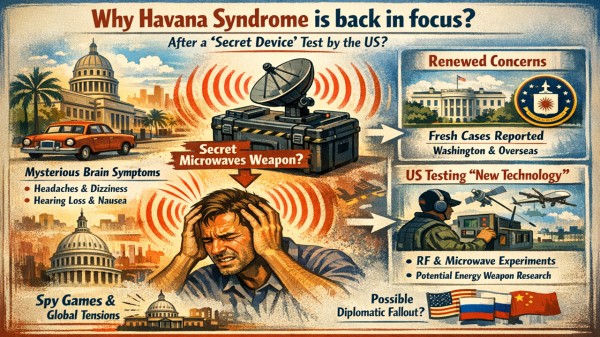
The currently burgeoning hysteria around the return of Havan Syndrome comes after reports came that the US Department of Defense (DoD) through Homeland Security Investigations acquired a mysterious piece of equipment in an undercover operation through a massively funded project.
While the reports are multiple and vary on several accounts, they suggest that the device is portable and appears to emit pulsed radio-frequency energy. This is being described as a source of directed energy that is thought to be analogous to what might underlie the symptoms associated with Havana Syndrome.
It reportedly contains components from Russia, though it’s not fully Russian-made, as officials briefed on the matter have reported to media publications. The reports further add that the Pentagon has been testing this device for over a year, but the exact purpose and results of those tests have not been publicly disclosed.
The renewed focus on Havana Syndrome has strategic, scientific and political implications. First of all it renews interest about a scientific and medical mystery which has conclusively not been solved till now. Theories do exist though, and the testing of a possible real-world device prompts fresh scrutiny of them. Furthermore, if the device is capable of producing harmful neurological effects as reports suggest, it raises questions of foreign actors and may result in diplomatic fallout if further implicative information is found.