Sign In
By signing in or creating an account, you agree with Associated Broadcasting Company's Terms & Conditions and Privacy Policy.
By signing in or creating an account, you agree with Associated Broadcasting Company's Terms & Conditions and Privacy Policy.
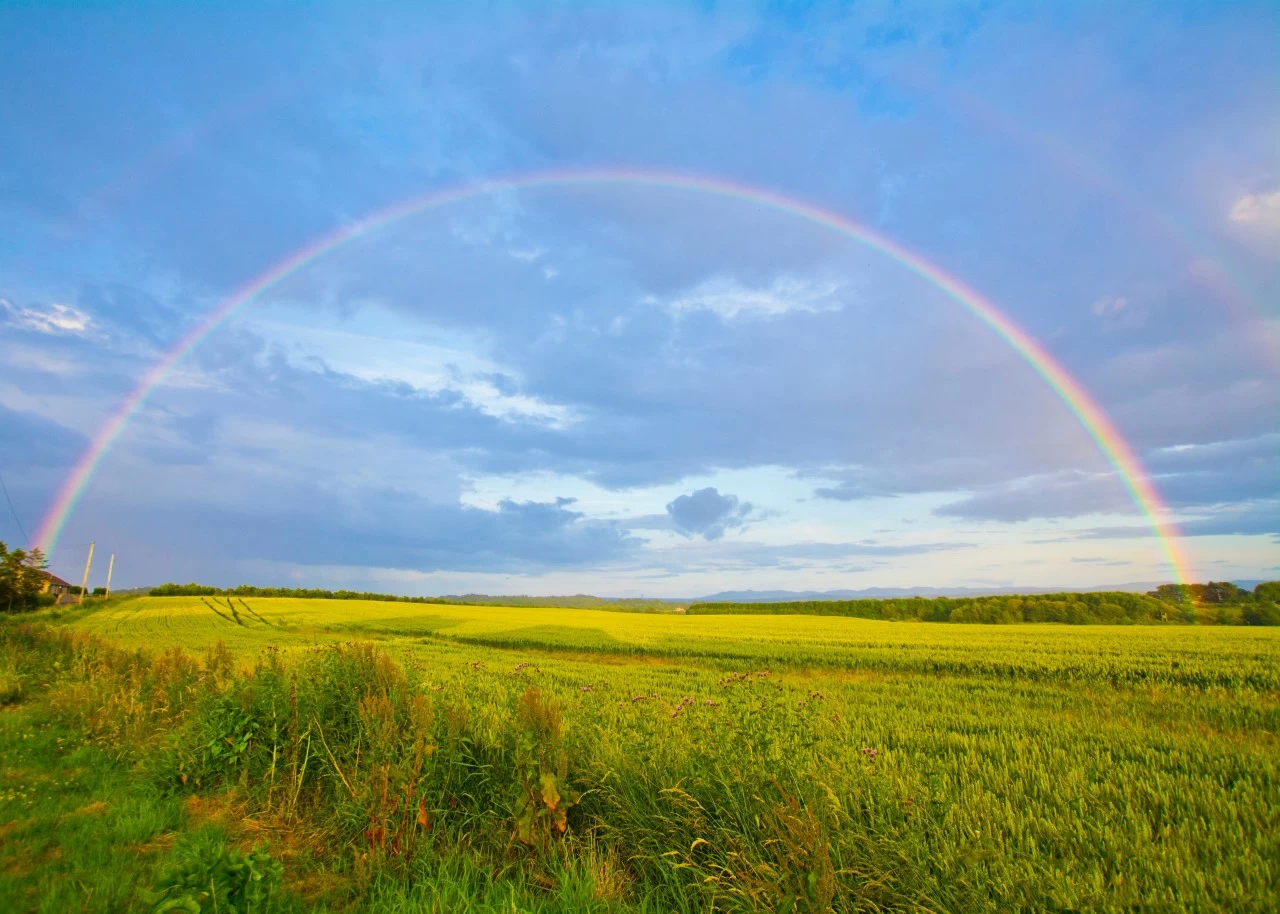


Rainbows are natural spectacles that often appear after a storm, given favourable conditions. They split the light from the Sun into constituent elements, displaying an arc spanning the entire spectrum of light visible to human eyes. Rainbows are formed from a complex interplay of light, water and the atmosphere, governed by the principles of refraction, reflection and dispersion. The bows are a result of sunlight interacting with raindrops suspended in the air.
When the light from the Sun passes through a raindrop, three processes take place. First, the light is refracted as it enters the droplet. Refraction is the bending of light as it moves from one medium to another with a different density. Here, the water is much denser than the surrounding air, that causes the light to shift its direction slightly. How much the light is diffracted, depends on its wavelength. Shorter wavelengths like blue and violet bend a lot more than the longer ones like yellow and red. The light then reflects off the inner surface of the droplet, bendinng once more as it exits back into the air, where it refracts for a second time.
The process results in a spectrum of colours. Now the rainbow forms an arc because of geometry. Raindrops act like tiny prisms, and the angle at which light exits them forms a cone of light that reaches the eyes of the observer. Red light bends about 42 degrees, with the bluer shades being slightly less. When a rainbow appears, the light is being refracted by countless raindrops, each contributing a specific colour at a specific angle. The circular arc appears because the droplets are spread across the sky, but the ground cuts off the lower half, so we only see a semicircle. In ideal viewing conditions, especially from higher altitudes, it is possible to see circular rainbows.
The order of the colours in the rainbow, violet, indigo, blue, green, yellow, orange and red is consistent because of how wavelengths disperse. Red, with the longest wavelength appears on the outer edge, while violet, which has the shortest, appears on the inner edge. Interestingly, the rainbow that each individual sees is unique to their perspective. Even someone standing a few metres away will see light refracted by a different set of raindrops, creating their own unique, personal rainbow.
Atmospheric conditions also play a role in the appearance of raindrops. It needs to be day time for rainbows, although moonbows are visible at night. It should also be raining. Rainbows often appear just after a storm clears and sunlight breaks through. The Sun has to be low on the horizon, less than 42 degrees for the rainbow to be visible. This is why rainbows are most commonly seen in the early mornings or late afternoons.
At times, secondary rainbows can appear with colours in the reverse order. These are formed from light reflecting twice within the raindrop before exiting at a slightly different angle, of about 50 degrees. The region between the primary and the secondary rainbow is called Alexander’s band, and appears darker because the light is redirected in other directions. Supernumerary rainbows are faint pink or green bands inside the primary arc, forming as a result of interference, where light waves reinforce or cancel out each other. These wave effects are enhanced by smaller, finer raindrops.