Sign In
By signing in or creating an account, you agree with Associated Broadcasting Company's Terms & Conditions and Privacy Policy.
By signing in or creating an account, you agree with Associated Broadcasting Company's Terms & Conditions and Privacy Policy.
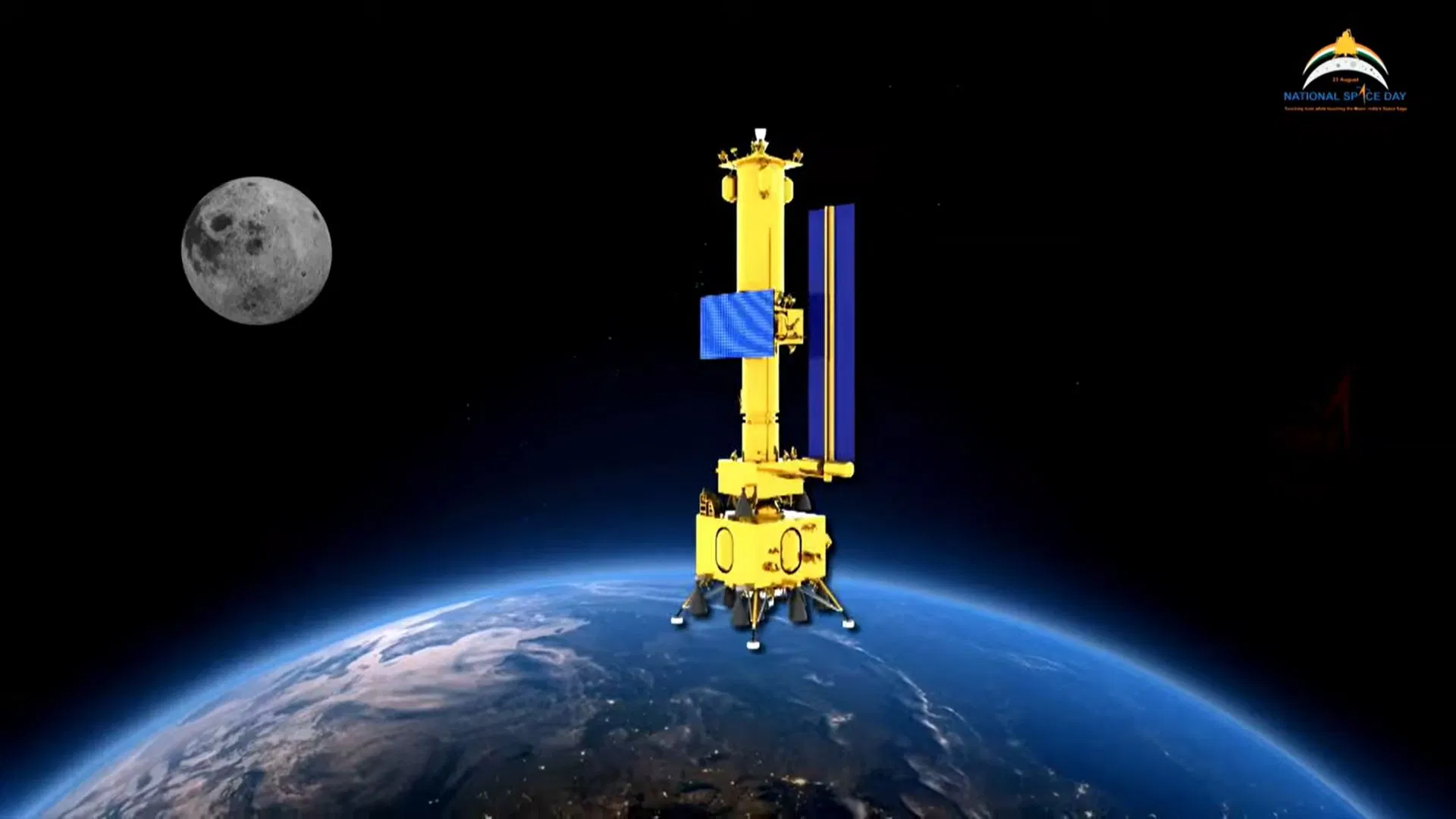


In a written response to a question posed at the Rajya Sabha, State Minister for Space Jitendra Singh revealed the landing location of ISRO's Chandrayaan 4 sample return mission. Singh stated, “The targeted landing site for Chandrayaan-4 is in the southern polar region of Moon (~84˚ to 86˚ south latitudes). This region is expected to be geologically diverse, having close proximity to Permanently Shadowed Regions (PSR) and having possibility of finding water ice, also the polar regions of Moon remain largely unexplored and global scientific community is focused on exploring it in detail.”
The Chandrayaan 4 mission is a sample return mission that will use both a scoop and a drill to dig up lunar regolith and return it to the Earth for detailed analysis by laboratories here. Chandrayaan 4 will be landing closer to the lunar south pole than the Chandrayaan 3 mission. ISRO was previously considering using an alternate landing site of the Chandrayaan 3 mission as the landing zone for the Chandrayaan 4 mission, at a latitude of about 70˚ south. The highlands around the south pole are believed to retain water delivered to the Moon in the chaotic infancy of the solar system by asteroids and comets. Sunlight never reaches the floors of the craters here, where water ice may exist.
ISRO's Chandrayaan 4 mission will be the most complex and ambitious interplanetary mission undertaken by ISRO. All the elements cannot possibly fit into a single rocket, so ISRO will be using a pair of LVM3 rockets, the most powerful operational rocket in its fleet. The first stack consists of an ascender and a lander, while the second stack is made up of the propulsion, transfer and reentry modules. The two stacks will link up in Earth orbit before the propulsion module carries the spacecraft to the Moon. The lander will then collect the samples, transfer them to the ascender, that will fly to lunar orbit and transfer the material to the transfer module, which will return to the Earth and release the reentry module towards the surface. ISRO plans to launch the Chandrayaan 4 mission in 2028.