Sign In
By signing in or creating an account, you agree with Associated Broadcasting Company's Terms & Conditions and Privacy Policy.
By signing in or creating an account, you agree with Associated Broadcasting Company's Terms & Conditions and Privacy Policy.
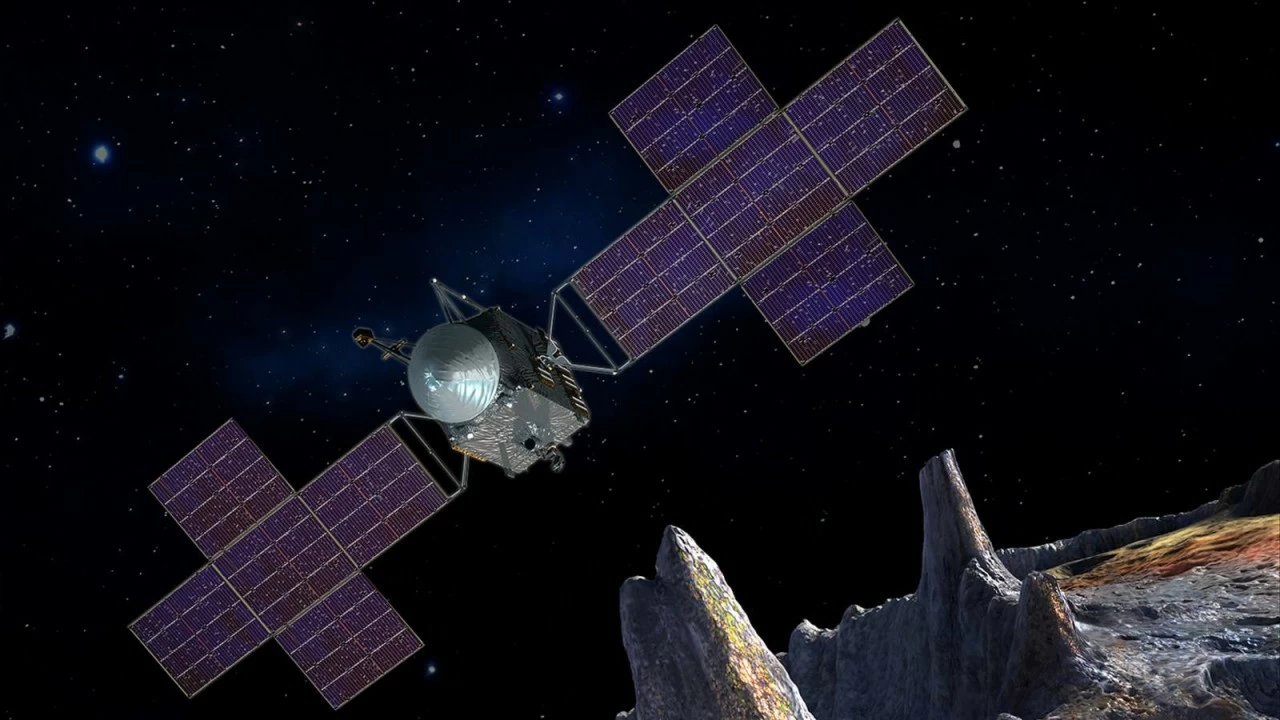


NASA launched the Psyche mission on 13 October, 2023 on a Falcon Heavy rocket from the Kennedy Space Center in Florida, USA. The spacecraft is headed to the asteroid 16 Psyche. The asteroid measures 280 kilometres across. Scientists estimate that between 30 to 60 per cent of the asteroid is composed of metals, primarily iron and nickel, based on radar and spectral data. The theory is that the asteroid is the core of a differentiated planetesimal that was battered to bits in the chaotic infancy of the Solar System.

The Psyche mission was launched by a SpaceX Falcon 9 on 13 October, 2023. (Image Credit: NASA).
The Psyche mission offers the rare opportunity to study the exposed core of a protoplanet. The asteroid may also be made entirely of pristine, unmelted, primordial metal, providing clues about the early composition of the Solar System. What a differentiated planetesimal means is a body with internal heat, that can melt rock, with a crust. In such conditions, the denser metals sink towards the core of the protoplanet, while the lighter silicates rise to the top. The body then froze, and was subsequently stripped by collisions, leaving behind an exposed core.
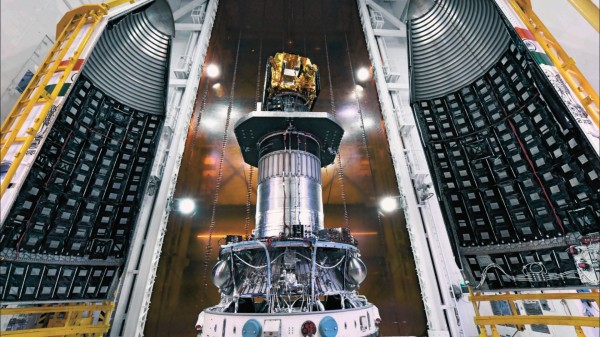
The spacecraft uses innovative solar-electric propulsion with Hall-effect thrusters. The solar arrays are 24 metres wide. It took three months for ground teams to check out all the systems on board were working as intended. Psyche is now headed for a gravity assist of Mars in May 2026, when it will speed up by stealing some of the rotational energy of the Red Planet, slowing it down by a tiny fraction. Psyche is scheduled to arrive at the asteroid of the same name in August 2029, after which it will spend 26 months studying the metallic asteroid.

Psyche uses large solar arrays and solar-electric propulsion. (Image Credit: NASA).
Once in orbit around Psyche, the spacecraft will gradually reduce its orbit from an altitude of 700 kilometres to 300 kilometres, then to 185 and 85 kilometres, collecting data from the four instruments on board. These include a multispectral imager for mapping the surface in more colours than a conventional camera, a gamma-ray and neutron spectrometer for investigating the elemental composition of the asteroid, a magnetometer for detecting and mapping the magnetic fields, and a radio system for measuring the gravity field. The science goals of Psyche are focused on understanding the nature of the asteroid.
If Psyche is indeed a planetary core, the spacecraft can reveal how differentiation occurred in the early Solar System bodies, that is how the protoplanet was layered like an onion into a core, mantle and crust. The core of the Earth is 2900 kilometres beneath the surface and is inaccessible, making Psyche a unique analogue. By studying this asteroid, scientists can understand more about the remote interior of the Earth.
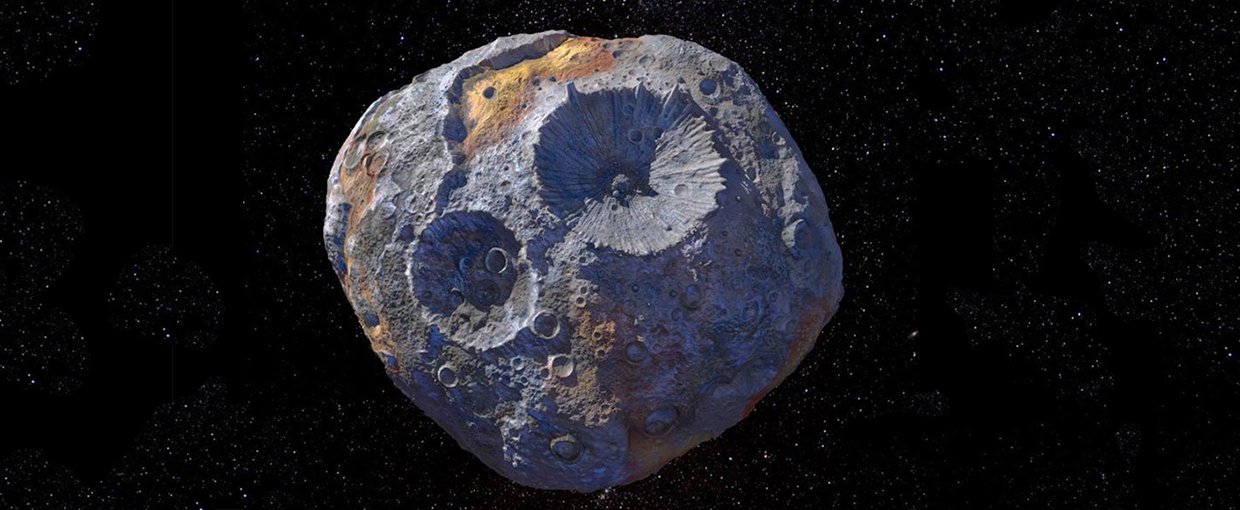
The target asteroid Psyche may be the core of a world battered to bits in the chaotic infancy of the Solar System. (Image Credit: NASA).
The core of the Earth produces the magnetic field that protects the surface from energetic particles. The magnetometer on the Psyche spacecraft will look for a remnant magnetic field on the asteroid, a sign of a past dynamo. The spectrometer will quantify the metal content, and will be able to detect silicates as well, testing the hypothesis that Psyche is a planetary core. If Psyche is composed of pristine, unprocessed, unmelted material, then scientists will have to rework their theories on planetary accretion, as they know of no other process that can result in such a concentration of metal.
Since the launch of Sputnik in 1957, humans have primarily used radio signals to communicate with spacecraft. These can easily pass through clouds in the atmosphere, but are limited in terms of bandwidth. Psyche is using a brand new technology that uses lasers to transmit data. This transmission was first tested on 14 November 2023, followed by a test on 11 December, 2023 when the spacecraft beamed back a 15 second ultra-high definition video from a distance of 31 million kilometres, or about 80 times the distance between the Earth and the Moon.
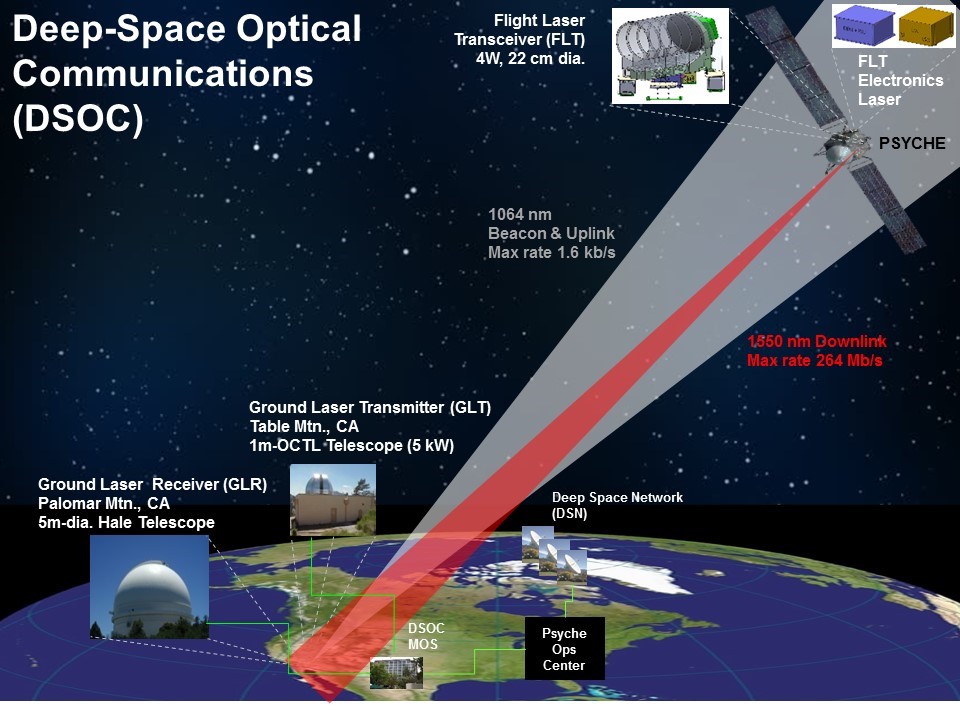
Psyche has successfully demonstrated data transmission using lasers. Radio waves have been primarily used for communicating with spacecraft since the launch of Sputnik. (Image Credit: NASA).
On 8 April, 2024 the Psyche spacecraft tested the Deep Space Optical Communications (DSOC) system again, from a distance of 225 million kilometres. The link reached speeds of 25 mbps, about 25 times in excess of the goal NASA had set for the mission. The signals can still be trapped by bad weather on Earth, but demonstrates the potential of high-bandwidth communications from deep space missions in the future. Such optical communication links can one day allow video calls to Mars.