Sign In
By signing in or creating an account, you agree with Associated Broadcasting Company's Terms & Conditions and Privacy Policy.
By signing in or creating an account, you agree with Associated Broadcasting Company's Terms & Conditions and Privacy Policy.
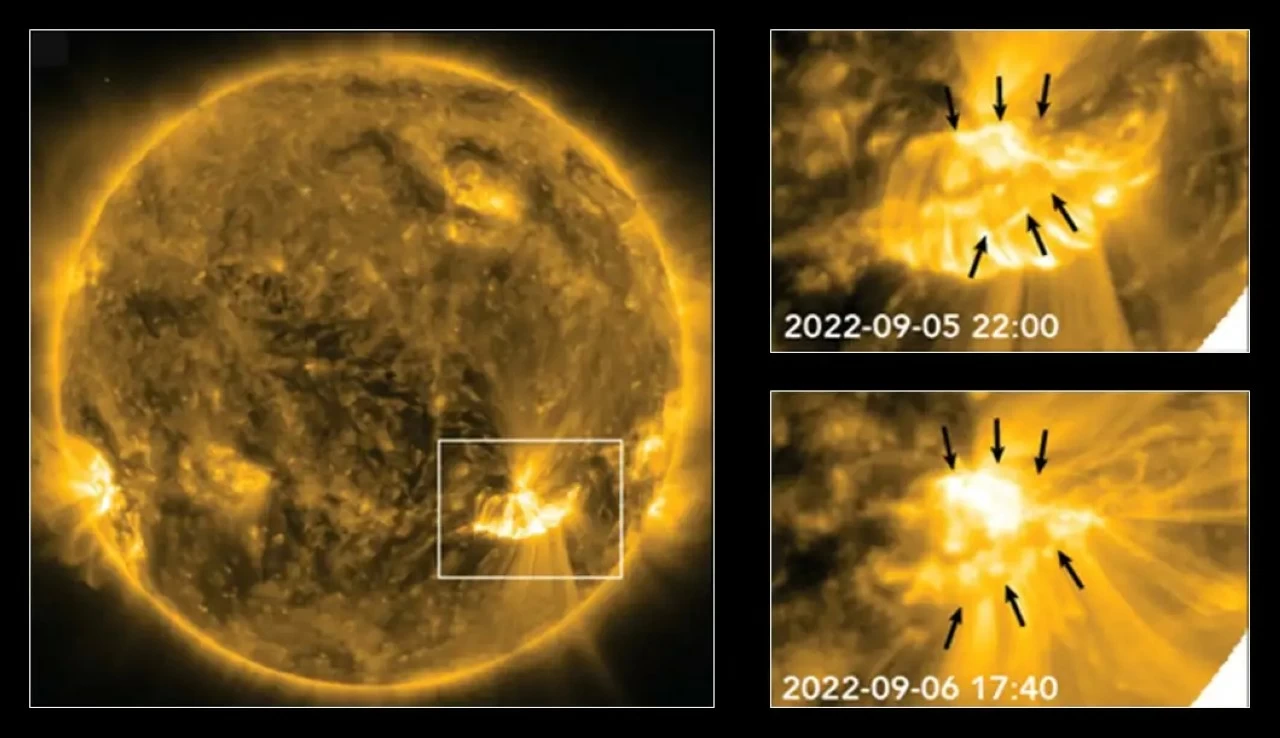


Between 5 and 6 September 2022, NASA's Parker Solar Probe was just in the right place at the right time, passing tangled magnetic fields undergoing a reorganisation known as magnetic reconnection. Such events release vast amounts of trapped energy. The same even was observed by a number of heliophysics observatories at greater distances, including ESA's Solar Orbiter. Data from both the probes indicate that the reconnection event lasted for over 24 hours, resulting in an arcade of coronal loops. A paper describing the research has been published in Nature Astronomy.
Scientists are interested in more accurately predicting magnetic reconnection events, as the associated solar flares, filament outbursts and coronal mass ejections can adversely impact energy distribution grids, satellites, and communications systems, that the modern human civilisation relies so heavily on. The Parker Solar Probe had fortuitously reached the closest point in its orbit during the flare, at an altitude of less than ten million km from the surface, or the photosphere. The Solar Orbiter simultaneously observed the Sun from a distance of 100 million km. The visible surface of the Sun is where the coronal magnetic fields originate.
The reconnection events are typically brief, resulting in violent outbursts of trapped plasma. The data from both the probes indicate that the reconnection event lasted around 24 hours, which is the longest for such an outburst. The observations will help scientists better understand how particles are accelerated into space during the magnetic reconnection events. The observations also confirm existing models describing the process. It is unclear why some reconnection events are short-lived, while others last for many hours. Incidentally, the Parker Solar Probe is making its closest approach so far right now on 15 September, with the final close approach scheduled for 12 December.