Sign In
By signing in or creating an account, you agree with Associated Broadcasting Company's Terms & Conditions and Privacy Policy.
By signing in or creating an account, you agree with Associated Broadcasting Company's Terms & Conditions and Privacy Policy.
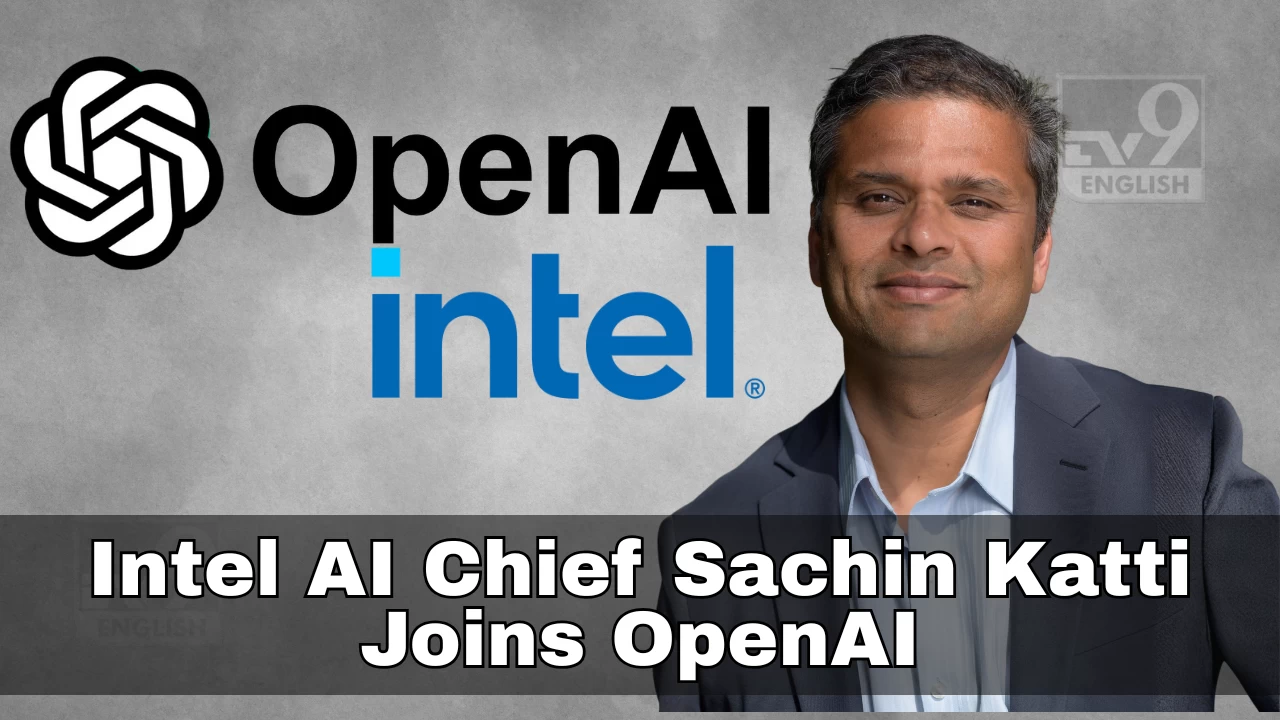

New Delhi: Intel’s top artificial intelligence executive, Sachin Katti, has left the company to join OpenAI, the creator of ChatGPT. His move comes at a time when OpenAI is expanding its hardware and compute capabilities to power its push toward artificial general intelligence (AGI). Katti will now play a central role in building and scaling the infrastructure that runs OpenAI’s growing AI systems.
OpenAI president and co-founder Greg Brockman shared the update on X, saying he is “incredibly excited to work with him on designing and building our compute infrastructure, which will power our AGI research and scale its applications to benefit everyone.” The announcement marks one of the most high-profile executive shifts in the global AI space this year.
At OpenAI, Katti will lead the design and expansion of the company’s compute backbone, the large-scale hardware infrastructure that fuels training and deployment of advanced AI models. His appointment signals OpenAI’s deeper investment in building its own computing foundation, reducing reliance on third-party chip suppliers.
The company has been scaling its infrastructure to support increasingly complex AI workloads, including its ongoing AGI research. Katti’s expertise in both chip architecture and large-scale networking is expected to help accelerate OpenAI’s roadmap for future AI systems.
Intel confirmed Katti’s exit in a statement and announced that CEO Lip-Bu Tan will now directly oversee its AI and advanced technology divisions. The company said, “AI remains one of Intel’s highest strategic priorities,” while thanking Katti for his contributions.
Intel added, “Lip-Bu will lead the AI and Advanced Technologies Groups, working closely with the team.” The change comes as Intel continues restructuring its leadership to focus on innovation in semiconductors and AI computing.
Under Tan’s leadership, Intel has brought in several key executives, including Kevork Kechichian from Arm and senior leader Naga Chandrasekaran, as part of its turnaround efforts.
Before joining OpenAI, Katti was senior vice president, chief technology and AI officer, and general manager of the Network and Edge Group (NEX) at Intel Corporation. He led Intel’s overall AI strategy, product roadmap, and research efforts through Intel Labs. He also guided the company’s developer and startup engagement initiatives and helped advance its networking and edge computing technologies.
Before his corporate career, Katti spent nearly 15 years at Stanford University as a professor of electrical engineering and computer science. His research in wireless communication and networking has been widely recognized, earning him the ACM Doctoral Dissertation Award (honourable mention) and the William Bennett Prize for Best Paper in IEEE/ACM Transactions on Networking.
He also co-founded two successful startups, Kumu Networks, known for breakthroughs in self-interference cancellation, and Uhana, which built AI-driven tools for mobile network optimisation before being acquired by VMware.
For OpenAI, hiring Katti signals a push to strengthen its hardware independence and enhance compute efficiency as AI models continue to grow in size and complexity. His blend of academic, entrepreneurial, and industrial experience fits well with the company’s long-term goal of scaling AGI research responsibly.
For Intel, the exit is another major leadership change in a year of transition. The company remains under pressure to regain ground against Nvidia in the AI hardware market. Nvidia’s GPUs dominate the high-performance computing space used for training large models, while Intel’s CPUs continue to serve other parts of the AI ecosystem.