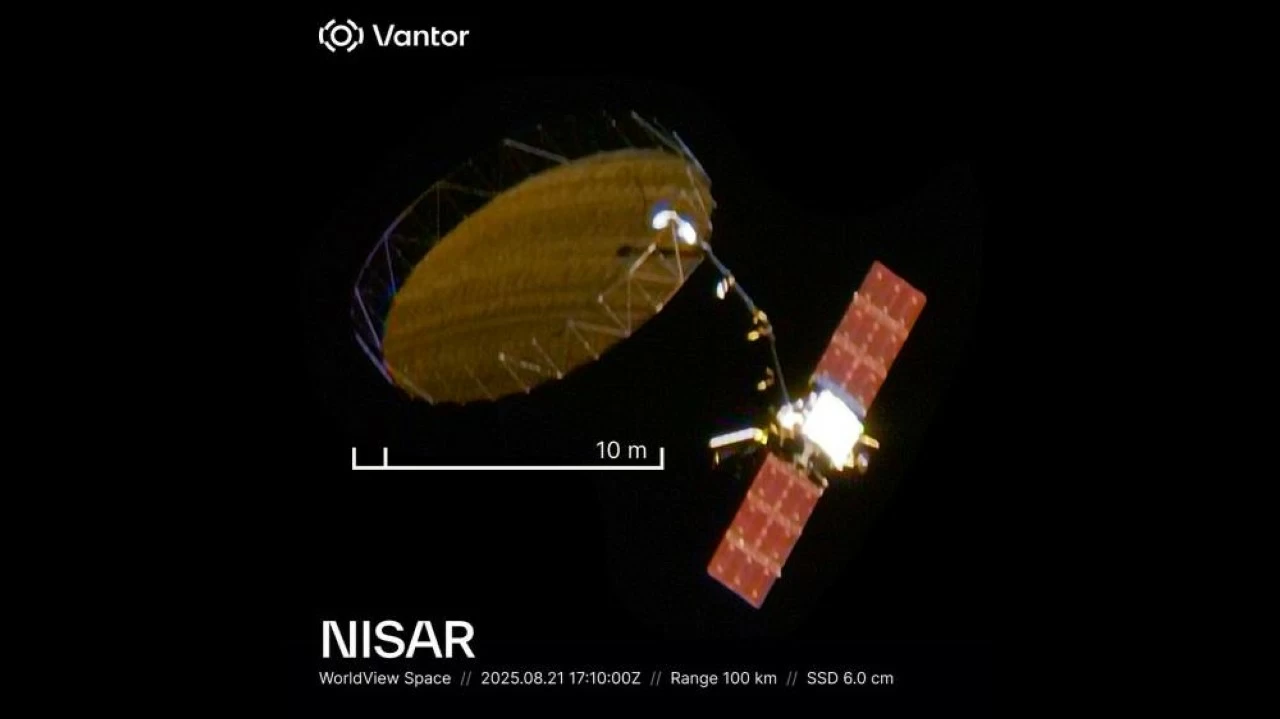
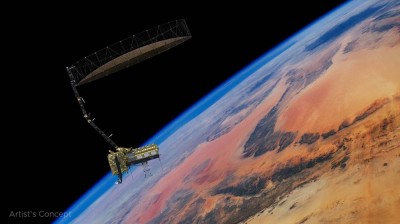
Vantor has captured the NASA-ISRO Synthetic Aperture Radar (NISAR) satellite in full bloom in Earth orbit, with centimeter-scale clarity. The image was captured after the NISAR satellite deployed its 12 metre wide radar reflector antenna, the largest of its kind to be deployed in space. This antenna was stowed away in the rocket for the bumpy ride to space, and was a single-point of failure of the mission, along with the nine-metre long boom and the launch vehicle. All the other elements of the mission are either redundant or designed to degrade gracefully. The imagery was captured after the
radar reflector antenna was deployed in August.
The images allows scientists to determine if the tensioning of the mesh and the deployment of the geometry matches the specifications, and if the satellite is oriented as desired in relation to the targets. The imaging allows Vantor to determine the velocity of the spacecraft, and confirm deployments that cannot be verified through telemetry from the satellite alone. There are very few satellites in the world capable of Non Earth Imaging (NEI), which is observations of other hardware in space, with most designed to either observe the Earth, or celestial and astronomical targets such as planets and distant galaxies.
Observations to commence in November
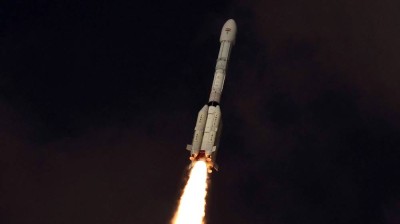
The NISAR satellite is the first collaboration of its kind between NASA's Jet Propulsion Laboratory in California and ISRO's Space Applications Centre in Ahmedabad. The satellite was launched on the
GSLV-F16 flight to a Sun Synchronous Polar Orbit on 30 July. The satellite is in good health, and has passed
all the system checks. The mission has started capturing
science-quality images, but the commissioning phase is still ongoing. The NISAR mission is expected to commence regular observations from November.